
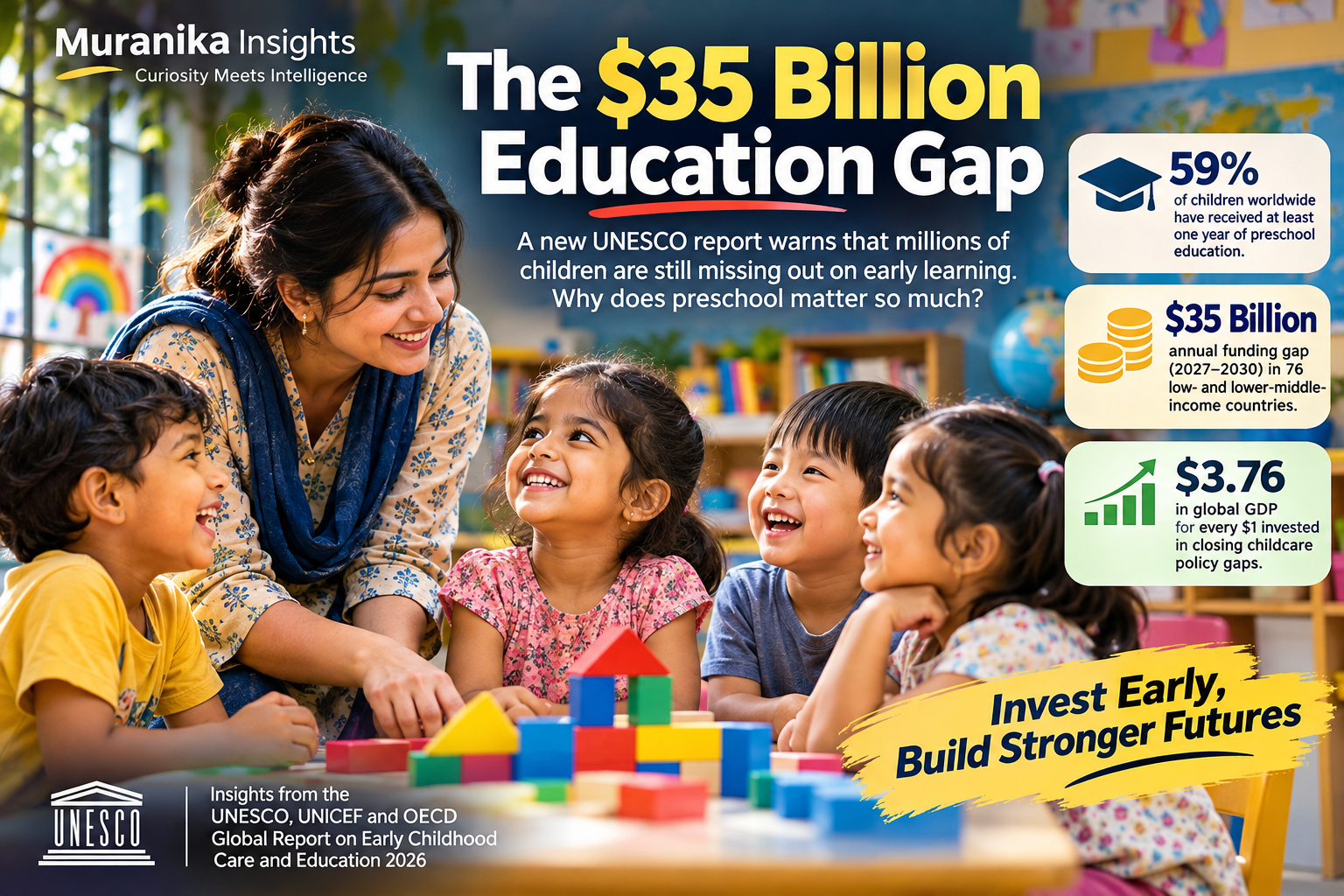
New UNESCO findings reveal that millions of children are missing essential early learning opportunities, while governments face a multibillion-dollar challenge to improve access.
November 22, 2026 | Muranika Editorial Team
The world invests enormous resources in universities, advanced technology, and workforce development. Yet millions of children are missing out on education during some of the most important years of their lives.
A new global report released by UNESCO on November 20, 2026, reveals that only 59% of children entering primary school worldwide have received at least one year of pre-primary education.
The findings highlight a troubling global imbalance: while early childhood education is widely recognized as essential for development, many countries still struggle to provide it consistently.
More concerning is the estimated $35 billion annual funding gap facing low- and lower-middle-income countries as they work toward their pre-primary education targets for 2030.
The findings come from UNESCO’s 2026 Global Report on Early Childhood Care and Education, developed jointly with UNICEF and the OECD, alongside new financing estimates from UNESCO’s Global Education Monitoring team.
What does the $35 billion education gap actually mean?
The headline figure represents the difference between the funding countries are expected to have available and the amount required to meet their preschool participation targets while maintaining minimum quality standards.
According to UNESCO’s financing analysis, covering 76 low- and lower-middle-income countries:
| Estimated annual financing, 2027–2030 | Amount |
|---|---|
| Funding required | $69 billion |
| Projected domestic public funding | $34 billion |
| Annual funding shortfall | $35 billion |
This is an estimated yearly gap for 2027–2030, not a single unpaid bill or a figure covering every country worldwide.
Closing the gap would involve building classrooms, training and recruiting educators, providing learning materials, and making preschool services affordable for families.
For many countries, expanding access without compromising quality will be a significant challenge.
Why are so many children missing preschool education?
UNESCO estimates that only 59% of children worldwide have attended preschool before entering primary school.
Although participation in organized learning has improved over the past two decades, progress has slowed significantly since 2015.
The differences between regions remain substantial.
In Europe, Northern America, Latin America, and the Caribbean, participation in education one year before primary school generally exceeds 90%.
In several other regions, including sub-Saharan Africa, participation remains much lower.
Family income, location, accessibility, and availability of trained educators can all affect whether a child receives early education.
For families facing economic difficulties, preschool costs may compete with essential expenses such as food, housing, and healthcare.
Consequently, children who could benefit greatly from early educational support may be among those least likely to receive it.
Why early childhood education matters
Preschool is not simply preparation for examinations or formal classroom instruction.
High-quality early childhood education can help children develop language, communication, social interaction, emotional regulation, and problem-solving skills.
Through storytelling, play, music, creative activities, and guided interaction, children develop abilities that support later learning.
These experiences can also help educators recognize when children need additional developmental support.
Importantly, effective preschool education should be age-appropriate.
Introducing formal academic pressure earlier is not necessarily the same as providing better early education.
The quality of interactions, learning environments, and support available to children matters as much as enrolment.
The global shortage of preschool educators
Financing is only part of the problem.
UNESCO estimates that the world will require approximately six million additional pre-primary educators by 2030.
The report also indicates that just 57% of pre-primary teachers in low-income countries meet minimum training requirements.
Recruiting more teachers is therefore not enough on its own.
Governments also need to invest in professional preparation, ongoing training, adequate facilities, and working conditions that help retain skilled educators.
Without those improvements, expanding preschool enrolment may produce overcrowded classrooms rather than better educational experiences.
The economic case for investing in young children
Beyond children’s individual development, early education has wider implications for families, communities, and national economies.
Accessible childcare and preschool services can help parents, particularly mothers, participate in employment or further education.
Improved early childhood support may also contribute to stronger educational outcomes and economic opportunities over time.
The new global report estimates that every dollar invested in closing childcare policy gaps could generate approximately $3.76 in additional global GDP by 2035.
This is a modelled economic projection, not a guaranteed financial return from every preschool programme.
Nevertheless, it reinforces an important principle: investments in early childhood services can create benefits that extend well beyond the classroom.
What does the report mean for India?
India offers an important example of the challenges involved in measuring access to early education.
UNESCO’s earlier 2026 Global Education Monitoring Report estimated that 51% of India’s five-year-olds were already enrolled in primary education rather than pre-primary education.
This finding requires careful interpretation.
Being enrolled in school does not necessarily mean a child has received a dedicated preschool experience.
It also highlights why statistics measuring participation in education may not fully capture the quality or type of learning children receive.
India’s challenge involves ensuring that young children can access appropriate early learning opportunities across rural and urban communities, including through well-supported community-based systems.
The broader question is not simply how early children enter formal schooling, but whether they receive suitable educational and developmental support.
What can governments do differently?
UNESCO recommends several actions to improve access and quality.
One priority is establishing predictable, long-term financing instead of relying on short-term programmes.
Another is directing additional resources toward disadvantaged communities, where families may face greater barriers to preschool participation.
Governments also need to coordinate education with healthcare, nutrition, social protection, and childcare services.
Such coordination matters because early childhood development is influenced by more than classroom teaching alone.
Finally, expanding affordable preschool access requires investment in the people who deliver these services.
Skilled educators, appropriate learning materials, and supportive environments are central to meaningful progress.
Why the next few years matter
The world has made important advances in expanding access to education.
However, the UNESCO findings demonstrate that millions of children still begin primary school without the early learning experiences available to many of their peers.
The estimated $35 billion annual financing gap is a reminder that commitments must be supported by practical investment.
Governments face difficult budget decisions, but early childhood education deserves serious consideration as part of long-term social and economic development.
The central issue is not merely how much countries spend on education.
It is also when, where, and how effectively that investment reaches children.
As the world approaches its 2030 education targets, the challenge will be to expand access while ensuring that the quality of early learning improves.
The bigger question
We frequently measure a country’s future through its universities, technological achievements, infrastructure, and economic growth.
But those achievements ultimately depend on people—and every person’s development begins long before higher education or employment.
Should countries invest more heavily in the earliest years of learning rather than waiting until educational inequalities become harder to overcome?
The new UNESCO report provides a compelling reason to reconsider how education budgets are distributed.
Sources and further reading
- UNESCO — Report Calls for Greater Investment in Pre-primary Education (November 20, 2026)
- UNESCO, UNICEF and OECD — Global Report on Early Childhood Care and Education 2026
- UNESCO GEM Report — How Much Would It Cost to Expand Pre-primary Education?
- UNESCO Global Education Monitoring Report 2026 — Access and Equity
© Muranika | Curiosity Meets Intelligence
https://muranika.com
Leave a Reply