November 13, 2026 | Science & Discoveries | Muranika Editorial Team
What does it take to guide a spacecraft safely toward the Moon? Powerful engines are only part of the answer. Behind the journey are sophisticated algorithms that help a spacecraft adjust its direction and respond to changing conditions.
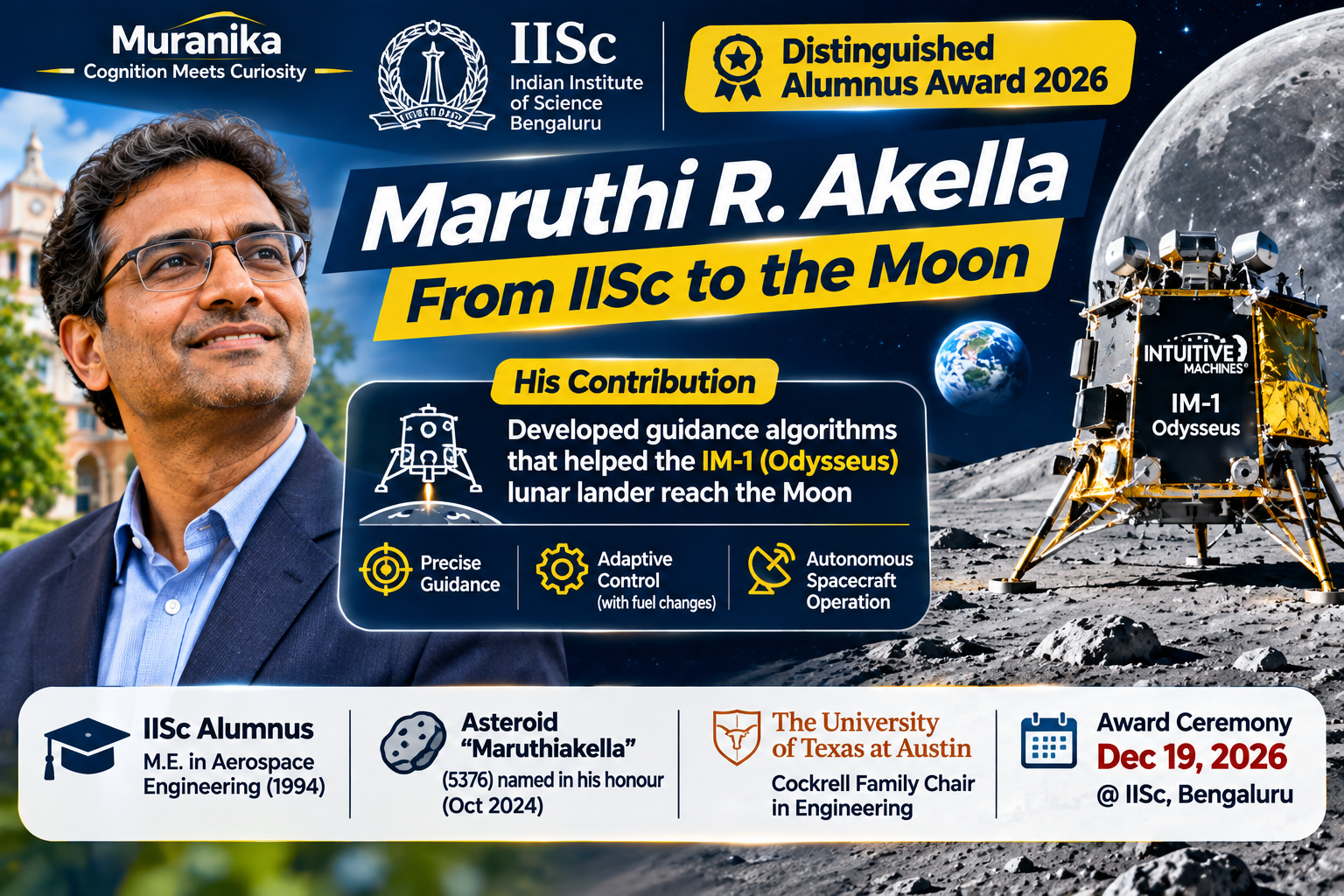
Indian-origin aerospace scientist Maruthi R. Akella, whose research team contributed to a historic lunar landing, has been selected for the Indian Institute of Science (IISc) Distinguished Alumnus Award 2026.
The recognition celebrates a remarkable scientific career spanning spacecraft guidance, autonomous systems, and advanced control engineering.
From Andhra Pradesh to International Space Research
Akella’s journey began in rural Andhra Pradesh, where he grew up with limited access to higher education.
His interest in mathematics and physics eventually led him to study mechanical engineering at the National Institute of Technology Calicut.
He later completed a Master of Engineering in Aerospace Engineering at IISc Bengaluru in 1994, followed by a PhD at Texas A&M University.
Since 1999, Akella has been a faculty member at the University of Texas at Austin, where he currently holds the Cockrell Family Chair in Engineering.
His research focuses on developing mathematical methods that allow spacecraft, robots, and other complex systems to operate reliably—even when conditions are uncertain.
How Did His Research Help a Spacecraft Reach the Moon?
One of Akella’s most notable achievements involves Intuitive Machines’ IM-1 mission, which delivered the Odysseuslunar lander to the Moon on February 22, 2024.
The mission marked the first US soft landing on the Moon since the Apollo era and the first commercial soft lunar landing.
Akella and his research team at the University of Texas supported the development of an onboard guidance algorithm designed to help the lander maintain accurate orientation and target its destination near the Moon’s south pole.
The Engineering Challenge: A Spacecraft That Changes as It Flies
An important challenge during the mission was that the lander’s mass distribution changed as its engine consumed fuel.
That matters because a spacecraft’s response to engine thrust depends partly on its mass distribution and centre of gravity.
Even small orientation errors can become significant during a precision landing.
The guidance approach needed to account for these changing conditions so the vehicle could maintain stable pointing during critical flight manoeuvres.
This is a practical example of how advanced mathematical research can contribute directly to space exploration.
The IM-1 mission was part of NASA’s Commercial Lunar Payload Services initiative. Although Odysseus ultimately came to rest on its side, it successfully reached the lunar surface and transmitted scientific and engineering data.
What Is Spacecraft Guidance and Control?
Spacecraft generally rely on three interconnected capabilities:
- Guidance: Determines the desired trajectory or direction.
- Navigation: Estimates the spacecraft’s position, velocity, and orientation.
- Control: Adjusts thrust and other mechanisms to follow the intended trajectory.
Unlike vehicles operating on Earth, distant spacecraft cannot always depend on immediate instructions from ground controllers.
Autonomous guidance and control systems help them respond to sensor information and changing flight conditions.
These technologies have applications beyond lunar missions, including satellite operations, autonomous aircraft, and advanced robotics.
An Asteroid Already Bears His Name
Akella’s contributions have also received recognition beyond Earth.
In October 2024, the International Astronomical Union named minor planet 5376 “Maruthiakella” in his honour.
The asteroid is located in the main asteroid belt between Mars and Jupiter.
He was also selected as a VAIBHAV Fellow in 2025, supporting scientific collaboration between international researchers and institutions in India.
IISc Distinguished Alumni Awards 2026
IISc announced its 2026 award recipients on November 6.
Akella is among five Distinguished Alumnus/Alumna Award recipients, alongside B. S. Manjunath, Dipankar Das Sarma, Jagannath Nayak, and Rajat Moona.
The awards ceremony is scheduled for December 19, 2026, at the JN Tata Auditorium on the IISc campus in Bengaluru.
Why This Achievement Matters
Akella’s career illustrates the connection between fundamental engineering research and real-world technological breakthroughs.
Algorithms developed through years of academic research can eventually contribute to missions operating hundreds of thousands of kilometres from Earth.
His recognition also highlights the role of Indian researchers and international university collaborations in advancing space technology.
As future lunar missions demand increasingly precise, reliable, and autonomous systems, guidance and control research will remain an important part of spacecraft engineering.