Muranika

Category: Education & Careers

Explore global education opportunities, scholarships, career development, professional skills, and international study pathways.

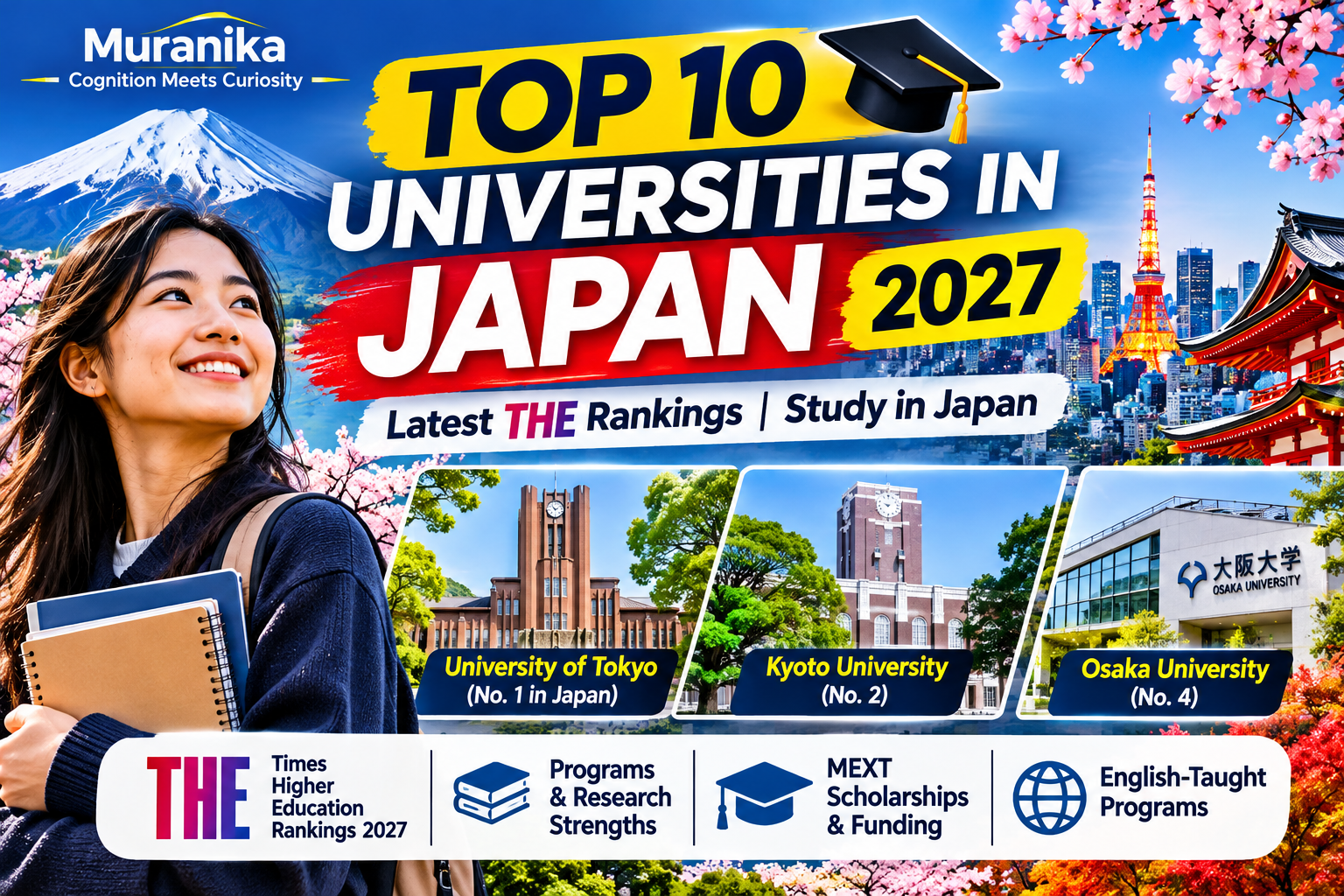
  • Top 10 Universities in Japan 2027: Latest THE Rankings & Study Guide

    Top 10 Universities in Japan 2027: Latest THE Rankings & Study Guide

    November 13, 2026 | Education & Careers | Muranika Editorial Team

    Which are the best universities in Japan for 2027? The latest Times Higher Education (THE) World University Rankings reveal Japan’s leading institutions, with the University of Tokyo retaining the country’s top position.

    For international students considering bachelor’s, master’s, or PhD studies in Japan, these rankings provide a useful starting point for comparing universities.

    The THE World University Rankings 2027, released in September 2026, include 112 universities from Japan.

    Top 10 Universities in Japan 2027

    According to Times Higher Education, the following universities occupy Japan’s top 10 ranking positions.

    Japan Rank University World Rank 2027
    1 University of Tokyo 27
    2 Kyoto University =62
    3 Tohoku University =106
    4 The University of Osaka =147
    5 Institute of Science Tokyo =185
    6 Nagoya University =242
    7 Kyushu University 301–325
    =8 Hokkaido University 376–400
    =8 University of Tsukuba 376–400
    =10 Hiroshima University 601–650
    =10 Juntendo University 601–650

    Source: Times Higher Education World University Rankings 2027. The list contains 11 institutions because two universities share 8th place and two share 10th place.

    What Stands Out in Japan’s 2027 Rankings?

    University of Tokyo Remains Japan’s No. 1

    The University of Tokyo continues to lead Japan, securing 27th position globally.

    Kyoto University follows in second place nationally, ranked joint 62nd worldwide.

    Both institutions remain among Japan’s most prominent research universities, attracting attention from students and researchers interested in advanced academic study.

    Tohoku and Osaka Maintain Strong Positions

    Tohoku University ranks third in Japan and joint 106th globally, while the University of Osaka occupies fourth place nationally and joint 147th worldwide.

    These institutions are important options for students exploring science, engineering, medical research, and interdisciplinary studies.

    Institute of Science Tokyo Ranks Fifth

    Institute of Science Tokyo holds fifth position nationally and joint 185th globally.

    The institution was established in October 2024 through the merger of Tokyo Institute of Technology and Tokyo Medical and Dental University.

    The merger brought together expertise in engineering, technology, medicine, and dentistry.

    Hokkaido and Tsukuba Share Eighth Place

    Hokkaido University and the University of Tsukuba both appear in the global 376–400 ranking band, sharing eighth place in Japan.

    Hiroshima University and Juntendo University also share tenth place, each appearing in the 601–650 global band.

    THE vs QS Rankings: Why Are the Results Different?

    Students may notice that the QS World University Rankings 2027 present a different order.

    For example, QS places the University of Osaka third in Japan, ahead of Tohoku University. It also ranks Waseda University and Keio University among Japan’s top ten.

    THE, meanwhile, places Tohoku University third and includes Hiroshima University and Juntendo University in its top ten positions.

    This doesn’t mean one ranking must be wrong.

    Different ranking organizations evaluate universities using different indicators and weightings.

    THE considers teaching, research environment, research quality, industry connections, and international outlook.

    QS includes indicators such as academic reputation, employer reputation, research citations, and internationalization.

    Which Japanese University Should International Students Choose?

    University rankings are useful, but the highest-ranked university isn’t automatically the best choice for every student.

    Before applying, consider five important factors:

    1. Your academic field: Compare the department, curriculum, laboratories, and research strengths.
    2. English-taught programs: Check whether your intended degree is available in English.
    3. Research supervision: Master’s and PhD applicants should investigate potential supervisors and research groups.
    4. Scholarship availability: Review current MEXT scholarship opportunities and university-specific funding.
    5. Living expenses and location: Tokyo, Kyoto, Sendai, Sapporo, and other university cities offer different living environments and costs.

    For research students, the suitability of the research laboratory and supervisor may matter more than a small difference in university rank.

    Can You Study at These Universities Through MEXT?

    Potentially, yes. Japan’s Ministry of Education, Culture, Sports, Science and Technology offers government scholarships through different selection routes, including embassy recommendation and university recommendation.

    However, being ranked among Japan’s top universities does not automatically mean a particular university or degree program has MEXT-funded places available.

    Students must verify the applicable scholarship category, eligibility requirements, university nomination arrangements, and current application guidelines.

    International applicants should also check official English-taught degree listings because available programs differ by institution and academic level.

    Final Thoughts

    The University of Tokyo, Kyoto University, and Tohoku University lead Japan in the THE World University Rankings 2027.

    However, students should look beyond the overall ranking when selecting where to study.

    A university that offers the right academic specialization, research supervisor, funding opportunities, and learning environment may provide a better fit than a higher-ranked institution with fewer suitable options.

    For international students planning to study in Japan in 2027 or beyond, these rankings offer a useful place to begin researching universities.

    Official Sources

    Editorial note: Rankings reflect the published 2027 editions. Admissions, scholarships, degree availability, and university requirements must be verified individually.
  • Micron Careers: Internships, Graduate Jobs & Engineering Opportunities

    Micron Careers: Internships, Graduate Jobs & Engineering Opportunities

    Updated November 13, 2026 | Jobs | Muranika Editorial Team

    Interested in starting or advancing your career in the semiconductor industry? Micron Technology offers career opportunities for university students, recent graduates, researchers, and experienced professionals working in engineering, manufacturing, information technology, and related fields.

    As a major developer and manufacturer of memory and storage technologies, Micron works on technologies that support artificial intelligence, data centers, smartphones, and modern computing.

    This guide explains how to explore Micron careers, find internship and graduate opportunities, understand engineering roles, and prepare a stronger job application.

    1. Micron Careers: Opportunities for Different Experience Levels

    Micron’s recruitment website provides several ways to explore employment opportunities.

    Applicant Where to start
    Current university students Micron Internship Program
    Recent B.Tech, Master’s or PhD graduates New College Grad Program
    Experienced engineers Micron Careers job search
    Research and technical professionals Relevant engineering and R&D vacancies
    Business and IT graduates Business and technology openings

    Available positions, eligibility requirements, and locations vary.

    2. Micron Internship Program for University Students

    Micron’s university recruiting program provides opportunities for students to gain practical industry experience.

    Depending on the role, internships may involve engineering, information technology, business, manufacturing, or related work.

    The company confirms that its internships are paid.

    When should students apply?

    Micron’s main university recruiting page describes a typical internship application period running from August through March, with many roles filled by the end of January.

    Campus recruitment activities generally take place between September and March, while the described internship program operates from May through August.

    These dates reflect the recruitment schedule described on Micron’s main university recruiting page. Actual schedules can differ by country, university, and individual position.

    Important: Internship applicants must be enrolled at a college or university and must not graduate before their internship ends.

    Official university recruiting information:

    https://www.micron.com/about/careers/university-recruiting

    3. Micron New College Grad Program

    The Micron New College Grad Program is designed to help eligible graduates transition into professional roles.

    Students graduating with relevant engineering, science, technology, or other qualifications can explore available early-career positions.

    Applicants from backgrounds such as electrical engineering, electronics, mechanical engineering, materials science, physics, and computer science may find suitable technical opportunities, depending on each job description.

    Unlike internships, Micron recruits for new graduate roles throughout the year.

    Candidates should review individual vacancies for degree requirements, graduation-year eligibility, work authorization, and required skills.

    4. Semiconductor Engineering Careers at Micron

    Beyond graduate programs, Micron’s careers platform provides opportunities for experienced professionals.

    For semiconductor engineers, useful job-search keywords include:

    Process Engineering: Semiconductor fabrication processes, process optimization, equipment performance, and defect reduction.

    Process Integration: Connecting fabrication processes to meet overall device performance and manufacturing requirements.

    Yield Engineering: Investigating yield losses, analyzing manufacturing data, and supporting process improvements.

    Equipment Engineering: Maintaining, optimizing, and improving advanced semiconductor manufacturing equipment.

    Materials and Metrology: Characterization, measurements, process monitoring, and materials-related development.

    Research and Development: Device technologies, semiconductor materials, memory architecture, and advanced manufacturing innovation.

    These descriptions explain common industry career paths. They do not mean that every position is currently available at Micron.

    5. Where Can You Find Micron Jobs?

    Micron’s global careers platform allows applicants to search by job title, keyword, and location.

    Countries and regions represented in its careers listings include the United States, Japan, India, Singapore, Taiwan, and Malaysia.

    For example, candidates interested in Japan can search for opportunities in Hiroshima, while applicants considering India can check listings in locations such as Hyderabad.

    The availability of individual roles changes regularly.

    Official Micron job-search portal:

    https://careers.micron.com/careers

    Official Micron careers overview:

    https://www.micron.com/about/careers/

    Applicants should use these official recruitment websites rather than relying on outdated job advertisements.

    6. How to Apply for Micron Jobs

    A practical approach is to:

    1. Visit the Micron careers portal and search for suitable positions.
    2. Filter by location and role to identify relevant opportunities.
    3. Review the complete job description, including required qualifications, experience, and technical skills.
    4. Prepare a tailored resume demonstrating relevant technical experience and accomplishments.
    5. Submit your application through the official recruitment portal.
    6. Prepare for interviews if selected for the next stage.

    Micron states that candidates may apply for multiple positions, provided they meet the relevant requirements.

    7. Resume and Interview Tips for Micron Applicants

    For technical roles, a generic resume may not communicate your strongest qualifications.

    Instead, highlight specific achievements.

    For example, a process-engineering candidate could explain experience with process optimization, design of experiments (DOE), equipment troubleshooting, data analysis, materials characterization, or manufacturing yield improvement.

    Where possible, support achievements with measurable results.

    Micron’s university recruiting guidance recommends explaining project responsibilities, challenges, and outcomes clearly.

    Depending on the role, interviews may assess technical fundamentals, problem-solving skills, previous experience, and behavioral competencies.

    Candidates should also prepare questions about the team, responsibilities, development opportunities, and work environment.

    8. Frequently Asked Questions

    Are Micron internships paid?

    Yes. Micron confirms that its internships are paid. The applicable salary and benefits depend on the position and location.

    Can international students apply?

    Eligibility depends on the specific vacancy, country, and applicable work-authorization requirements. Applicants should confirm these conditions before applying.

    Does Micron provide relocation support?

    Micron describes housing and transportation arrangements for its US internship program and possible lump-sum relocation assistance for new graduates. These arrangements should not be assumed to apply to every position or country.

    Can PhD graduates apply for engineering positions?

    Yes, PhD graduates can explore relevant technical and research positions. The appropriate experience level and qualifications depend on the role.

    When are Micron jobs announced?

    Micron recruits for different positions throughout the year. Internship recruiting follows a more structured cycle, while experienced-hire vacancies appear according to business requirements.

    Final Thoughts

    Micron Technology offers several pathways into the semiconductor industry, from university internships and graduate opportunities to specialized engineering and research positions.

    For students, the university recruiting page is a useful starting point. Experienced professionals can explore openings through Micron’s global careers portal.

    The most effective approach is to identify positions that genuinely match your background, prepare a role-specific resume, and apply directly through official recruitment channels.

    Official Sources

    Disclaimer: Muranika is an independent information website and is not affiliated with Micron Technology. This article provides general career guidance, not an announcement of a specific vacancy. Available jobs, application requirements, benefits, and recruitment schedules may change. Verify details on Micron’s official careers website.

  • Rice University Postdoctoral Fellowship 2027: $75,000 Salary, Eligibility and Deadline

    Rice University Postdoctoral Fellowship 2027: $75,000 Salary, Eligibility and Deadline

    November 13, 2026 | Jobs | Muranika Editorial Team

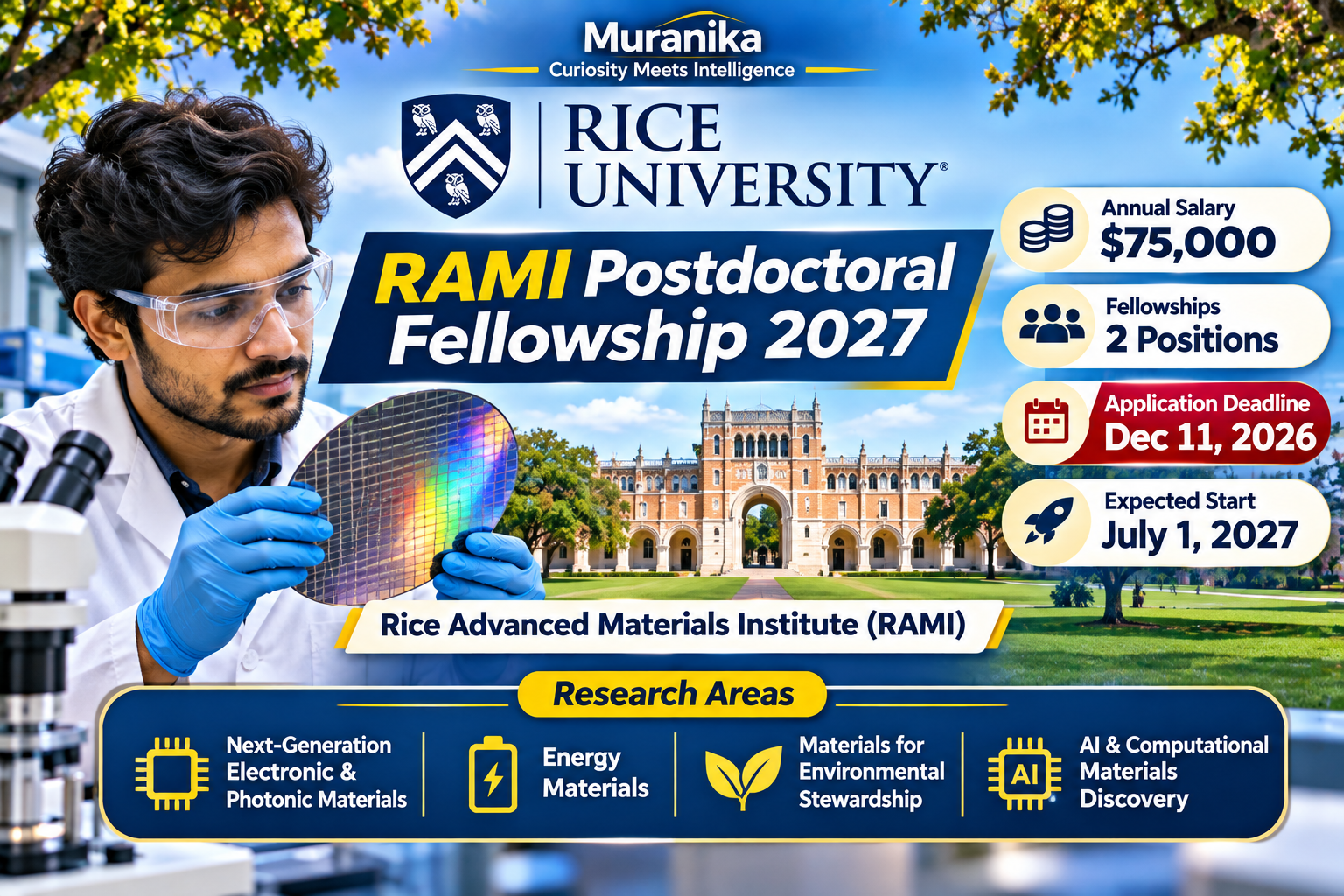
    Looking for a postdoctoral research opportunity in the United States? Rice University has announced its RAMI Postdoctoral Fellowship Program 2027, offering an annual salary of $75,000 for selected researchers working in advanced materials science and engineering.

    The fellowship supports early-career scientists pursuing interdisciplinary research in next-generation electronics, energy materials, environmental sustainability, and advanced materials discovery.

    Applications are currently open, with a deadline of December 11, 2026.

    Rice University RAMI Fellowship 2027: Key Details

    Detail Information
    University Rice University, United States
    Program RAMI Postdoctoral Fellowship 2027
    Research Institute Rice Advanced Materials Institute
    Annual Salary $75,000
    Fellowship Duration Intended for two years
    Expected Fellowships 2
    Application Deadline December 11, 2026, 5 PM CST
    Expected Start Date July 1, 2027

    The appointment is reviewed after the first year. Continuation into the second year depends on satisfactory performance and available funding.

    Research Areas: Who Should Apply?

    The Rice Advanced Materials Institute aims to advance innovative materials research addressing technological, energy, and environmental challenges.

    The program covers three major research areas.

    1. Next-Generation Electronic and Photonic Materials

    This area includes research related to semiconductor materials, microelectronics, advanced devices, quantum materials, two-dimensional materials, materials processing, fabrication, and characterization.

    Researchers working on electronic materials, nanotechnology, thin films, or semiconductor device technologies may find relevant opportunities within this research area.

    2. Energy Materials

    This research area explores innovative approaches to energy storage, energy conversion, and energy harvesting.

    Potential topics include advanced batteries, solid-state materials, thermal energy storage, and materials for more efficient energy technologies.

    3. Materials for Environmental Stewardship

    Researchers interested in environmental sustainability, catalysis, resource recovery, membranes, carbon capture, and materials recycling may find this area relevant.

    Additional research theme: RAMI also welcomes interdisciplinary research involving artificial intelligence, machine learning, computational approaches, and automation to accelerate materials discovery, design, and manufacturing.

    Eligibility Requirements

    Applicants should carefully review the following requirements:

    • Hold a PhD in a discipline relevant to RAMI’s research areas.
    • Have received their PhD in July 2025 or later, or expect to receive it before beginning the fellowship.
    • Have no more than two years of postdoctoral experience at other institutions by July 1, 2027.
    • Have no prior employment as an assistant, associate, or full professor by July 1, 2027.
    • Demonstrate excellent research achievements and strong potential for future scientific contributions.
    • For international nominees, demonstrate eligibility for J-1 Scholar visa status.

    Important: The fellowship requires nomination by an eligible RAMI-affiliated Rice University faculty member. Interested researchers should identify a suitable potential faculty host before preparing their application.

    The institute particularly encourages proposals that connect different materials research disciplines and create new collaborative research directions.

    Required Application Documents

    The application must include:

    1. Curriculum Vitae (CV)

    A research-focused academic CV highlighting qualifications, publications, research experience, presentations, and achievements.

    2. Faculty Nomination Letter

    A nomination letter from the proposed Rice University faculty advisor or advisors explaining the candidate’s research accomplishments and suitability.

    3. Research Proposal

    The research proposal must contain four sections:

    Proposal component Maximum length
    Research objectives and goals 350 words
    Connection to RAMI research areas 150 words
    Research background, challenges, novelty and expected outcomes 1,000 words
    Expected impact on Rice research and future funding opportunities 500 words

    The proposal should follow the university’s specified formatting requirements, including 11-point font and single-spaced text.

    How to Apply for the RAMI Postdoctoral Fellowship

    The process involves identifying an eligible Rice University faculty host, developing an interdisciplinary research proposal, and assembling the required documents.

    The completed application can be submitted by either the candidate or the faculty mentor, provided all required materials are included. The faculty nomination letter may be sent separately according to the institute’s instructions.

    Official program details:

    https://rami.rice.edu/rami-postdoctoral-fellowship-program

    Official application form:

    https://form.jotform.com/260073627903153

    Application deadline: December 11, 2026, at 5 PM Central Standard Time (CST).

    RAMI states that late submissions will only be considered if the initial applications do not meet the required standards. Applicants should therefore aim to submit before the published deadline.

    Selection Process and Fellowship Timeline

    Applications will be evaluated based on the candidate’s scientific achievements, originality of the research proposal, interdisciplinary contribution, and potential impact on Rice University’s materials research activities.

    The institute expects to award approximately two fellowships in this selection round.

    Successful candidates are expected to be announced around the end of January 2027, with appointments scheduled to begin on July 1, 2027.

    Final Thoughts

    The Rice University RAMI Postdoctoral Fellowship 2027 offers an opportunity for eligible early-career researchers to pursue interdisciplinary research in advanced materials, semiconductors, energy technologies, and AI-assisted materials innovation.

    With a $75,000 annual salary and opportunities for research collaboration, the program may appeal to promising PhD graduates seeking to establish an independent research career.

    Interested candidates should review the official eligibility requirements and contact a suitable Rice faculty member early to explore the possibility of nomination.

    Source: Rice Advanced Materials Institute, Rice University.

    Disclaimer: Muranika is an independent information website and is not affiliated with Rice University or its recruitment process. Fellowship details are based on the official announcement reviewed November 13, 2026. Applicants should verify requirements and deadlines directly with the university.

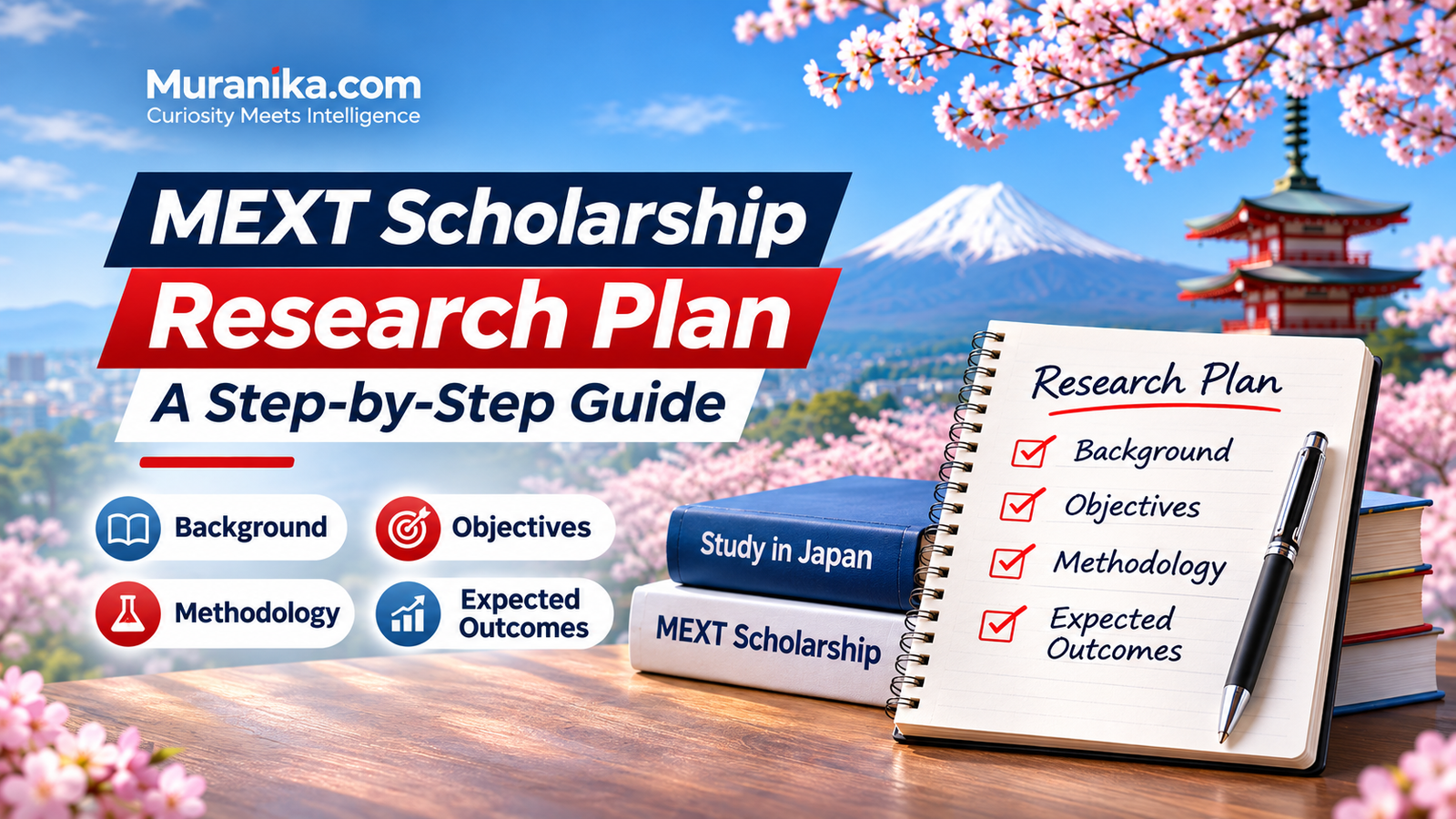
  • How to Write a Research Plan for the MEXT Scholarship: A Step-by-Step Guide

    How to Write a Research Plan for the MEXT Scholarship: A Step-by-Step Guide

    Updated November 11, 2026 | Education & Careers → MEXT Scholarships | Muranika Editorial Team

    Planning to pursue a master’s degree, PhD, or research programme in Japan through the MEXT Scholarship? One of the most important documents you may need is a well-structured research plan.

    A strong research plan explains not only what you want to study, but also why your research matters, how you intend to carry it out, and what you expect to achieve.

    Whether you’re preparing for the MEXT 2027 selection cycle or exploring future opportunities, understanding how to present your research ideas can help strengthen your application.

    What Is a MEXT Scholarship Research Plan?

    The research plan is a document describing your proposed academic research in Japan.

    For the Embassy Recommendation research-student pathway, the official document is called the Field of Study and Research Plan.

    It helps reviewers understand your academic background, proposed research direction, and preparedness for graduate-level research.

    Applicants should use the official format and instructions for their application year. University Recommendation programmes may have additional or different requirements.

    5 Essential Components of a Strong Research Plan

    1. Research Background

    Introduce your research area and explain the problem you want to investigate.

    Briefly describe existing research, identify a knowledge gap, and explain why your proposed study is relevant.

    2. Research Objectives

    Clearly define what you aim to accomplish.

    Instead of making broad statements, identify specific research questions or objectives that can realistically be addressed during your proposed study period.

    3. Research Methodology

    Explain how you plan to conduct your research.

    Depending on your discipline, this may include experiments, simulations, surveys, data analysis, laboratory investigations, or theoretical methods.

    The methodology should connect directly to your research objectives.

    4. Expected Outcomes

    Describe the results or contributions you hope your research will produce.

    These might include new scientific knowledge, improved processes, analytical methods, technological applications, or solutions to practical problems.

    Avoid promising results that cannot reasonably be guaranteed.

    5. Research Significance

    Explain why your proposed research matters to your field and what value it may offer.

    You can also discuss how studying in Japan would support your research, particularly when relevant university laboratories, expertise, or facilities align with your proposal.

    Common Research Plan Mistakes to Avoid

    Applicants sometimes weaken their proposals by:

    • Choosing topics that are too broad or poorly defined.
    • Providing insufficient background or research justification.
    • Presenting unrealistic objectives or research timelines.
    • Describing methods without explaining how they answer the research questions.
    • Failing to demonstrate a connection between previous academic experience and proposed research.
    • Submitting a generic plan without considering the intended university or research environment.

    A good research plan doesn’t need unnecessarily complicated language. Clarity, feasibility, and academic relevance are more valuable than impressive terminology.

    Watch: How to Prepare Your MEXT Research Plan

    For a more detailed explanation, watch our video covering research background, objectives, methodology, expected outcomes, and common application mistakes.

    Watch: MEXT Field of Study and Research Plan 2.0

    The video provides practical guidance for organizing your research ideas and preparing a stronger proposal.

    Additional MEXT Scholarship Resources

    You may also find these educational videos useful:

    These videos share educational guidance and experiences from scholarship recipients. Older selection dates and procedures should always be checked against current official announcements.

    Where to Find the Official MEXT Research Plan Form

    Applicants should download the appropriate documents directly from official Japanese government sources.

    Study in Japan — MEXT Scholarship 2027 Research Student Application

    For University Recommendation, consult the prospective university’s admissions and scholarship instructions.

    Final Thoughts

    Preparing a successful MEXT research proposal requires more than choosing an interesting topic. It involves identifying a meaningful research problem, developing achievable objectives, and demonstrating a realistic plan for investigating it.

    Start early, understand your chosen research field, and revise your proposal carefully before submission.

    A thoughtful research plan can help communicate your academic potential, although scholarship selection depends on multiple evaluation factors.

    What is the biggest challenge you’re facing while preparing your MEXT research plan? Share your question in the comments.


    Editorial note: This guide is intended for educational purposes. Always follow the latest MEXT application guidelines and instructions issued by your Japanese embassy or prospective university.

  • Japan Updates List of 93 Universities for Two-Year Job Search Stay: Who Qualifies?

    Japan Updates List of 93 Universities for Two-Year Job Search Stay: Who Qualifies?

    November 10, 2026 | Education & Careers | Muranika Editorial Team

    Japan has updated its list of 93 universities whose eligible graduates may qualify to stay in the country for up to two years while searching for employment or preparing to launch a business.

    The updated list, announced by Japan’s Immigration Services Agency on November 4, 2026, is part of the country’s J-Find (Future Creation Talent) immigration programme.

    The initiative offers graduates from highly ranked universities an opportunity to explore careers and entrepreneurship in Japan without first securing a job offer.

    What Is Japan’s J-Find Visa?

    Introduced in April 2023, J-Find provides eligible graduates with a special residence status called Designated Activities (Future Creation Talent).

    Under this programme, qualifying individuals may:

    • Stay in Japan for up to two years while seeking employment.
    • Explore opportunities to establish a business.
    • Undertake permitted work activities to support their stay.
    • Bring eligible spouses and children under applicable immigration rules.

    The two-year period is a maximum, and residence extensions are subject to immigration procedures and approval.

    Who Can Apply for J-Find?

    According to Japan’s Immigration Services Agency, applicants must satisfy three main conditions:

    1. University qualification: Hold an eligible degree from a university ranked among the world’s top 100 in at least two of three major global rankings: QS, Times Higher Education (THE), and Academic Ranking of World Universities (ARWU).
    2. Recent graduation: Have obtained the qualifying degree within the previous five years.
    3. Financial resources: Possess at least ¥200,000 to cover initial living expenses.

    Meeting these conditions does not automatically guarantee visa approval.

    Which Universities Are Included?

    The October 2026 list contains 93 universities across several countries and regions.

    Examples include Harvard University, Stanford University, Massachusetts Institute of Technology (MIT), University of Oxford, University of Cambridge, National University of Singapore, and Nanyang Technological University.

    Japan’s published list also includes the University of Tokyo and Kyoto University.

    The universities are predominantly located in the United States, United Kingdom, China, and other parts of Asia and Europe.

    What About Graduates From India and Africa?

    One notable aspect of the updated list is that no universities located in India or Africa appear among the 93 institutions.

    This means a degree obtained solely from an Indian or African university does not satisfy the current listed-university requirement.

    However, nationality itself is not the deciding factor. An Indian, Nigerian, or other international graduate who earned a qualifying degree from an eligible institution may still satisfy the educational requirement.

    Applicants should verify all applicable immigration conditions before applying.

    Does J-Find Guarantee Employment in Japan?

    No. The programme provides time to search for opportunities, but it does not guarantee a job, salary, or long-term residence.

    Graduates who secure suitable employment generally need an appropriate employment-related residence status to continue working beyond the permitted activities and duration of J-Find.

    The scheme is particularly relevant to internationally educated graduates exploring Japan’s technology, engineering, research, and business sectors.

    Where Can You Check the Official University List?

    Japan’s Immigration Services Agency updated its eligible university list on November 4, 2026, using rankings current as of October 2026.

    Because university rankings and eligibility lists can change, applicants should confirm the latest requirements before submitting an application.

    Official information: Japan Immigration Services Agency

    Latest government announcements: Immigration Services Agency Updates

    Final Thoughts

    Japan’s J-Find programme offers a potentially valuable pathway for eligible international graduates who want to explore employment or entrepreneurship in the country.

    However, the university ranking requirement remains a significant limitation, particularly for applicants who studied at institutions outside the current list.

    For graduates considering Japan as their next career destination, checking eligibility early can help avoid unnecessary application expenses and disappointment.

    Would you consider moving to Japan if you had two years to explore career opportunities? Share your thoughts in the comments.


    Sources: Japan Immigration Services Agency, official J-Find programme guidance and November 4, 2026 update; Legit.ng report published November 4, 2026.

    This article provides general information and does not constitute immigration or legal advice.

  • MEXT Scholarship Rejected: 9 MUST KNOW Reasons | Dark Reality Behind Selections

    MEXT Scholarship Rejected: 9 MUST KNOW Reasons | Dark Reality Behind Selections

    Facing rejection in the MEXT Scholarship can be disappointing, but understanding the reasons behind it can help you come back stronger. In this video, we reveal 9 must-know reasons why applicants get rejected and uncover the lesser-known realities behind the selection process. Learn about common mistakes in research plans, weak interviews, incomplete applications, and other critical factors that can impact your chances. This guide will help you identify where things might have gone wrong and how to improve your strategy for the next attempt. Whether you’re applying again or preparing for the first time, these insights will give you a clearer direction toward success. Watch now to learn, improve, and increase your chances of securing the MEXT Scholarship! #MEXTScholarship #StudyInJapan #ScholarshipRejected #MEXTTips #StudyAbroad #JapanScholarship #ScholarshipAdvice #MEXT2026 #HigherEducation #StudentSuccess