Muranika

Author: Muranika Editorial Team

  • Top 10 Universities in Japan 2027: Latest THE Rankings & Study Guide

    Top 10 Universities in Japan 2027: Latest THE Rankings & Study Guide

    November 13, 2026 | Education & Careers | Muranika Editorial Team

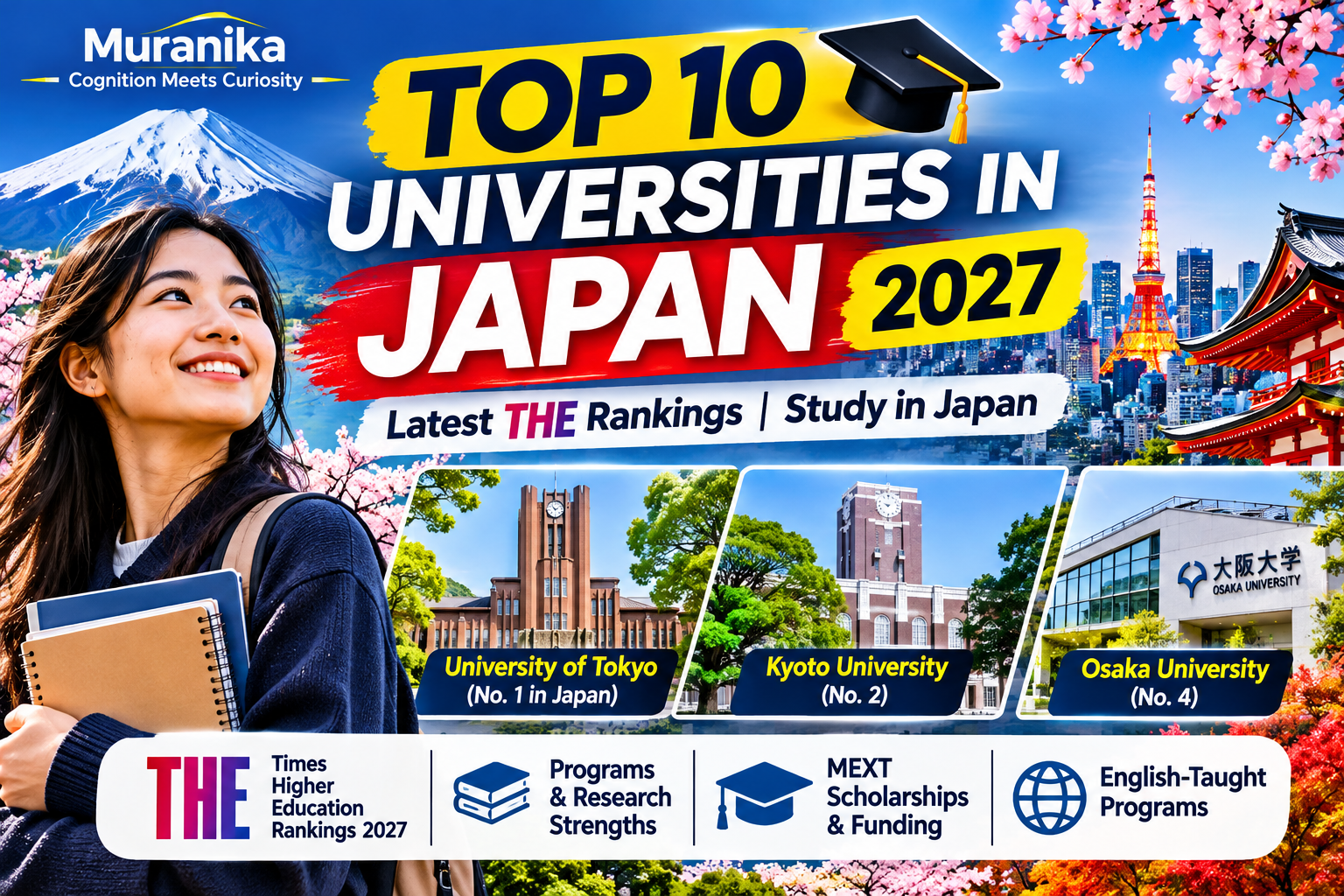
    Which are the best universities in Japan for 2027? The latest Times Higher Education (THE) World University Rankings reveal Japan’s leading institutions, with the University of Tokyo retaining the country’s top position.

    For international students considering bachelor’s, master’s, or PhD studies in Japan, these rankings provide a useful starting point for comparing universities.

    The THE World University Rankings 2027, released in September 2026, include 112 universities from Japan.

    Top 10 Universities in Japan 2027

    According to Times Higher Education, the following universities occupy Japan’s top 10 ranking positions.

    Japan Rank University World Rank 2027
    1 University of Tokyo 27
    2 Kyoto University =62
    3 Tohoku University =106
    4 The University of Osaka =147
    5 Institute of Science Tokyo =185
    6 Nagoya University =242
    7 Kyushu University 301–325
    =8 Hokkaido University 376–400
    =8 University of Tsukuba 376–400
    =10 Hiroshima University 601–650
    =10 Juntendo University 601–650

    Source: Times Higher Education World University Rankings 2027. The list contains 11 institutions because two universities share 8th place and two share 10th place.

    What Stands Out in Japan’s 2027 Rankings?

    University of Tokyo Remains Japan’s No. 1

    The University of Tokyo continues to lead Japan, securing 27th position globally.

    Kyoto University follows in second place nationally, ranked joint 62nd worldwide.

    Both institutions remain among Japan’s most prominent research universities, attracting attention from students and researchers interested in advanced academic study.

    Tohoku and Osaka Maintain Strong Positions

    Tohoku University ranks third in Japan and joint 106th globally, while the University of Osaka occupies fourth place nationally and joint 147th worldwide.

    These institutions are important options for students exploring science, engineering, medical research, and interdisciplinary studies.

    Institute of Science Tokyo Ranks Fifth

    Institute of Science Tokyo holds fifth position nationally and joint 185th globally.

    The institution was established in October 2024 through the merger of Tokyo Institute of Technology and Tokyo Medical and Dental University.

    The merger brought together expertise in engineering, technology, medicine, and dentistry.

    Hokkaido and Tsukuba Share Eighth Place

    Hokkaido University and the University of Tsukuba both appear in the global 376–400 ranking band, sharing eighth place in Japan.

    Hiroshima University and Juntendo University also share tenth place, each appearing in the 601–650 global band.

    THE vs QS Rankings: Why Are the Results Different?

    Students may notice that the QS World University Rankings 2027 present a different order.

    For example, QS places the University of Osaka third in Japan, ahead of Tohoku University. It also ranks Waseda University and Keio University among Japan’s top ten.

    THE, meanwhile, places Tohoku University third and includes Hiroshima University and Juntendo University in its top ten positions.

    This doesn’t mean one ranking must be wrong.

    Different ranking organizations evaluate universities using different indicators and weightings.

    THE considers teaching, research environment, research quality, industry connections, and international outlook.

    QS includes indicators such as academic reputation, employer reputation, research citations, and internationalization.

    Which Japanese University Should International Students Choose?

    University rankings are useful, but the highest-ranked university isn’t automatically the best choice for every student.

    Before applying, consider five important factors:

    1. Your academic field: Compare the department, curriculum, laboratories, and research strengths.
    2. English-taught programs: Check whether your intended degree is available in English.
    3. Research supervision: Master’s and PhD applicants should investigate potential supervisors and research groups.
    4. Scholarship availability: Review current MEXT scholarship opportunities and university-specific funding.
    5. Living expenses and location: Tokyo, Kyoto, Sendai, Sapporo, and other university cities offer different living environments and costs.

    For research students, the suitability of the research laboratory and supervisor may matter more than a small difference in university rank.

    Can You Study at These Universities Through MEXT?

    Potentially, yes. Japan’s Ministry of Education, Culture, Sports, Science and Technology offers government scholarships through different selection routes, including embassy recommendation and university recommendation.

    However, being ranked among Japan’s top universities does not automatically mean a particular university or degree program has MEXT-funded places available.

    Students must verify the applicable scholarship category, eligibility requirements, university nomination arrangements, and current application guidelines.

    International applicants should also check official English-taught degree listings because available programs differ by institution and academic level.

    Final Thoughts

    The University of Tokyo, Kyoto University, and Tohoku University lead Japan in the THE World University Rankings 2027.

    However, students should look beyond the overall ranking when selecting where to study.

    A university that offers the right academic specialization, research supervisor, funding opportunities, and learning environment may provide a better fit than a higher-ranked institution with fewer suitable options.

    For international students planning to study in Japan in 2027 or beyond, these rankings offer a useful place to begin researching universities.

    Official Sources

    Editorial note: Rankings reflect the published 2027 editions. Admissions, scholarships, degree availability, and university requirements must be verified individually.
  • Maruthi R. Akella Honoured by IISc: How His Research Helped Guide a Moon Landing

    Maruthi R. Akella Honoured by IISc: How His Research Helped Guide a Moon Landing

    November 13, 2026 | Science & Discoveries | Muranika Editorial Team

    What does it take to guide a spacecraft safely toward the Moon? Powerful engines are only part of the answer. Behind the journey are sophisticated algorithms that help a spacecraft adjust its direction and respond to changing conditions.

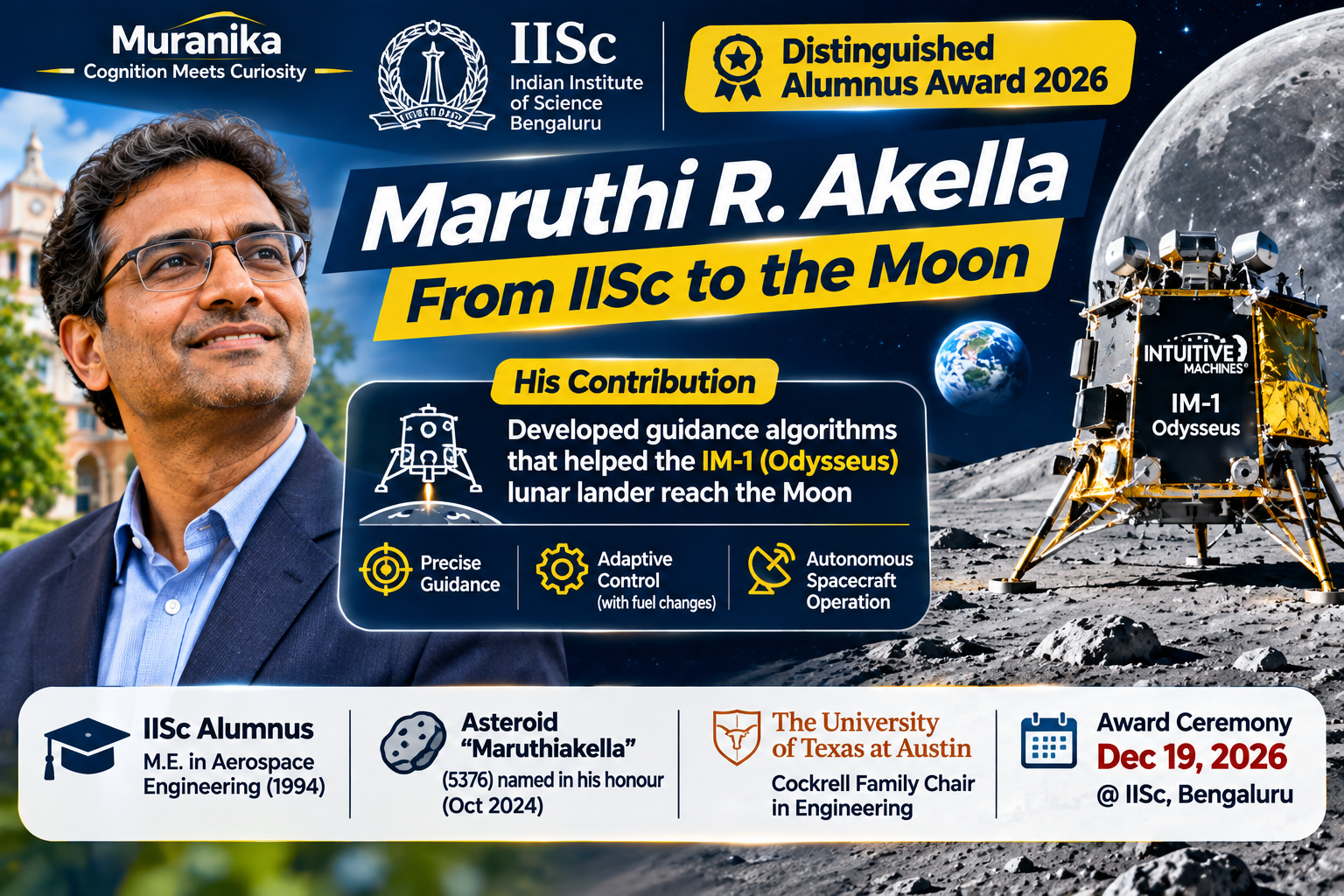
    Indian-origin aerospace scientist Maruthi R. Akella, whose research team contributed to a historic lunar landing, has been selected for the Indian Institute of Science (IISc) Distinguished Alumnus Award 2026.

    The recognition celebrates a remarkable scientific career spanning spacecraft guidance, autonomous systems, and advanced control engineering.

    From Andhra Pradesh to International Space Research

    Akella’s journey began in rural Andhra Pradesh, where he grew up with limited access to higher education.

    His interest in mathematics and physics eventually led him to study mechanical engineering at the National Institute of Technology Calicut.

    He later completed a Master of Engineering in Aerospace Engineering at IISc Bengaluru in 1994, followed by a PhD at Texas A&M University.

    Since 1999, Akella has been a faculty member at the University of Texas at Austin, where he currently holds the Cockrell Family Chair in Engineering.

    His research focuses on developing mathematical methods that allow spacecraft, robots, and other complex systems to operate reliably—even when conditions are uncertain.

    How Did His Research Help a Spacecraft Reach the Moon?

    One of Akella’s most notable achievements involves Intuitive Machines’ IM-1 mission, which delivered the Odysseuslunar lander to the Moon on February 22, 2024.

    The mission marked the first US soft landing on the Moon since the Apollo era and the first commercial soft lunar landing.

    Akella and his research team at the University of Texas supported the development of an onboard guidance algorithm designed to help the lander maintain accurate orientation and target its destination near the Moon’s south pole.

    The Engineering Challenge: A Spacecraft That Changes as It Flies

    An important challenge during the mission was that the lander’s mass distribution changed as its engine consumed fuel.

    That matters because a spacecraft’s response to engine thrust depends partly on its mass distribution and centre of gravity.

    Even small orientation errors can become significant during a precision landing.

    The guidance approach needed to account for these changing conditions so the vehicle could maintain stable pointing during critical flight manoeuvres.

    This is a practical example of how advanced mathematical research can contribute directly to space exploration.

    The IM-1 mission was part of NASA’s Commercial Lunar Payload Services initiative. Although Odysseus ultimately came to rest on its side, it successfully reached the lunar surface and transmitted scientific and engineering data.

    What Is Spacecraft Guidance and Control?

    Spacecraft generally rely on three interconnected capabilities:

    • Guidance: Determines the desired trajectory or direction.
    • Navigation: Estimates the spacecraft’s position, velocity, and orientation.
    • Control: Adjusts thrust and other mechanisms to follow the intended trajectory.

    Unlike vehicles operating on Earth, distant spacecraft cannot always depend on immediate instructions from ground controllers.

    Autonomous guidance and control systems help them respond to sensor information and changing flight conditions.

    These technologies have applications beyond lunar missions, including satellite operations, autonomous aircraft, and advanced robotics.

    An Asteroid Already Bears His Name

    Akella’s contributions have also received recognition beyond Earth.

    In October 2024, the International Astronomical Union named minor planet 5376 “Maruthiakella” in his honour.

    The asteroid is located in the main asteroid belt between Mars and Jupiter.

    He was also selected as a VAIBHAV Fellow in 2025, supporting scientific collaboration between international researchers and institutions in India.

    IISc Distinguished Alumni Awards 2026

    IISc announced its 2026 award recipients on November 6.

    Akella is among five Distinguished Alumnus/Alumna Award recipients, alongside B. S. Manjunath, Dipankar Das Sarma, Jagannath Nayak, and Rajat Moona.

    The awards ceremony is scheduled for December 19, 2026, at the JN Tata Auditorium on the IISc campus in Bengaluru.

    Why This Achievement Matters

    Akella’s career illustrates the connection between fundamental engineering research and real-world technological breakthroughs.

    Algorithms developed through years of academic research can eventually contribute to missions operating hundreds of thousands of kilometres from Earth.

    His recognition also highlights the role of Indian researchers and international university collaborations in advancing space technology.

    As future lunar missions demand increasingly precise, reliable, and autonomous systems, guidance and control research will remain an important part of spacecraft engineering.

    Sources and Further Reading

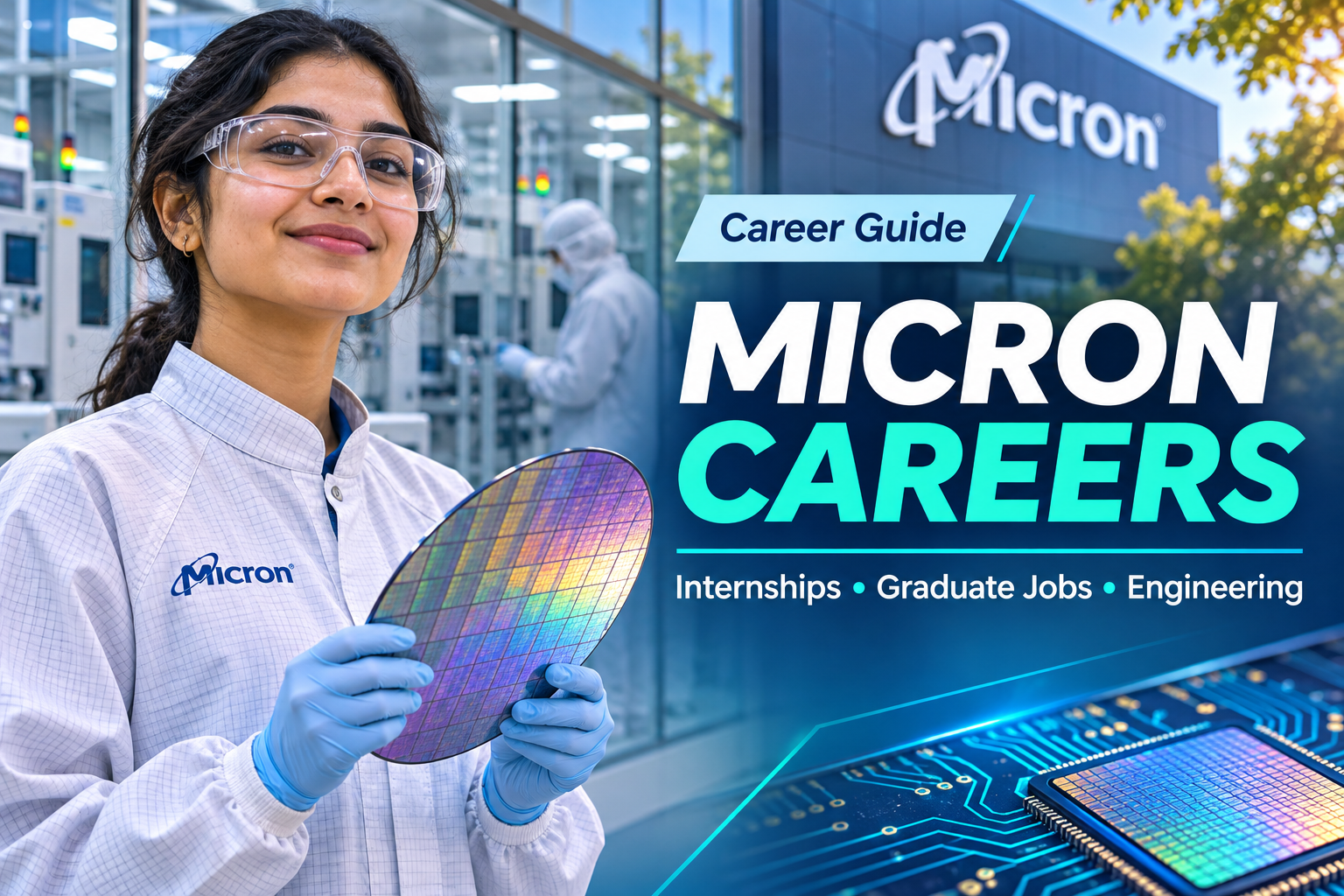
  • Micron Careers: Internships, Graduate Jobs & Engineering Opportunities

    Micron Careers: Internships, Graduate Jobs & Engineering Opportunities

    Updated November 13, 2026 | Jobs | Muranika Editorial Team

    Interested in starting or advancing your career in the semiconductor industry? Micron Technology offers career opportunities for university students, recent graduates, researchers, and experienced professionals working in engineering, manufacturing, information technology, and related fields.

    As a major developer and manufacturer of memory and storage technologies, Micron works on technologies that support artificial intelligence, data centers, smartphones, and modern computing.

    This guide explains how to explore Micron careers, find internship and graduate opportunities, understand engineering roles, and prepare a stronger job application.

    1. Micron Careers: Opportunities for Different Experience Levels

    Micron’s recruitment website provides several ways to explore employment opportunities.

    Applicant Where to start
    Current university students Micron Internship Program
    Recent B.Tech, Master’s or PhD graduates New College Grad Program
    Experienced engineers Micron Careers job search
    Research and technical professionals Relevant engineering and R&D vacancies
    Business and IT graduates Business and technology openings

    Available positions, eligibility requirements, and locations vary.

    2. Micron Internship Program for University Students

    Micron’s university recruiting program provides opportunities for students to gain practical industry experience.

    Depending on the role, internships may involve engineering, information technology, business, manufacturing, or related work.

    The company confirms that its internships are paid.

    When should students apply?

    Micron’s main university recruiting page describes a typical internship application period running from August through March, with many roles filled by the end of January.

    Campus recruitment activities generally take place between September and March, while the described internship program operates from May through August.

    These dates reflect the recruitment schedule described on Micron’s main university recruiting page. Actual schedules can differ by country, university, and individual position.

    Important: Internship applicants must be enrolled at a college or university and must not graduate before their internship ends.

    Official university recruiting information:

    https://www.micron.com/about/careers/university-recruiting

    3. Micron New College Grad Program

    The Micron New College Grad Program is designed to help eligible graduates transition into professional roles.

    Students graduating with relevant engineering, science, technology, or other qualifications can explore available early-career positions.

    Applicants from backgrounds such as electrical engineering, electronics, mechanical engineering, materials science, physics, and computer science may find suitable technical opportunities, depending on each job description.

    Unlike internships, Micron recruits for new graduate roles throughout the year.

    Candidates should review individual vacancies for degree requirements, graduation-year eligibility, work authorization, and required skills.

    4. Semiconductor Engineering Careers at Micron

    Beyond graduate programs, Micron’s careers platform provides opportunities for experienced professionals.

    For semiconductor engineers, useful job-search keywords include:

    Process Engineering: Semiconductor fabrication processes, process optimization, equipment performance, and defect reduction.

    Process Integration: Connecting fabrication processes to meet overall device performance and manufacturing requirements.

    Yield Engineering: Investigating yield losses, analyzing manufacturing data, and supporting process improvements.

    Equipment Engineering: Maintaining, optimizing, and improving advanced semiconductor manufacturing equipment.

    Materials and Metrology: Characterization, measurements, process monitoring, and materials-related development.

    Research and Development: Device technologies, semiconductor materials, memory architecture, and advanced manufacturing innovation.

    These descriptions explain common industry career paths. They do not mean that every position is currently available at Micron.

    5. Where Can You Find Micron Jobs?

    Micron’s global careers platform allows applicants to search by job title, keyword, and location.

    Countries and regions represented in its careers listings include the United States, Japan, India, Singapore, Taiwan, and Malaysia.

    For example, candidates interested in Japan can search for opportunities in Hiroshima, while applicants considering India can check listings in locations such as Hyderabad.

    The availability of individual roles changes regularly.

    Official Micron job-search portal:

    https://careers.micron.com/careers

    Official Micron careers overview:

    https://www.micron.com/about/careers/

    Applicants should use these official recruitment websites rather than relying on outdated job advertisements.

    6. How to Apply for Micron Jobs

    A practical approach is to:

    1. Visit the Micron careers portal and search for suitable positions.
    2. Filter by location and role to identify relevant opportunities.
    3. Review the complete job description, including required qualifications, experience, and technical skills.
    4. Prepare a tailored resume demonstrating relevant technical experience and accomplishments.
    5. Submit your application through the official recruitment portal.
    6. Prepare for interviews if selected for the next stage.

    Micron states that candidates may apply for multiple positions, provided they meet the relevant requirements.

    7. Resume and Interview Tips for Micron Applicants

    For technical roles, a generic resume may not communicate your strongest qualifications.

    Instead, highlight specific achievements.

    For example, a process-engineering candidate could explain experience with process optimization, design of experiments (DOE), equipment troubleshooting, data analysis, materials characterization, or manufacturing yield improvement.

    Where possible, support achievements with measurable results.

    Micron’s university recruiting guidance recommends explaining project responsibilities, challenges, and outcomes clearly.

    Depending on the role, interviews may assess technical fundamentals, problem-solving skills, previous experience, and behavioral competencies.

    Candidates should also prepare questions about the team, responsibilities, development opportunities, and work environment.

    8. Frequently Asked Questions

    Are Micron internships paid?

    Yes. Micron confirms that its internships are paid. The applicable salary and benefits depend on the position and location.

    Can international students apply?

    Eligibility depends on the specific vacancy, country, and applicable work-authorization requirements. Applicants should confirm these conditions before applying.

    Does Micron provide relocation support?

    Micron describes housing and transportation arrangements for its US internship program and possible lump-sum relocation assistance for new graduates. These arrangements should not be assumed to apply to every position or country.

    Can PhD graduates apply for engineering positions?

    Yes, PhD graduates can explore relevant technical and research positions. The appropriate experience level and qualifications depend on the role.

    When are Micron jobs announced?

    Micron recruits for different positions throughout the year. Internship recruiting follows a more structured cycle, while experienced-hire vacancies appear according to business requirements.

    Final Thoughts

    Micron Technology offers several pathways into the semiconductor industry, from university internships and graduate opportunities to specialized engineering and research positions.

    For students, the university recruiting page is a useful starting point. Experienced professionals can explore openings through Micron’s global careers portal.

    The most effective approach is to identify positions that genuinely match your background, prepare a role-specific resume, and apply directly through official recruitment channels.

    Official Sources

    Disclaimer: Muranika is an independent information website and is not affiliated with Micron Technology. This article provides general career guidance, not an announcement of a specific vacancy. Available jobs, application requirements, benefits, and recruitment schedules may change. Verify details on Micron’s official careers website.

  • Rice University Postdoctoral Fellowship 2027: $75,000 Salary, Eligibility and Deadline

    Rice University Postdoctoral Fellowship 2027: $75,000 Salary, Eligibility and Deadline

    November 13, 2026 | Jobs | Muranika Editorial Team

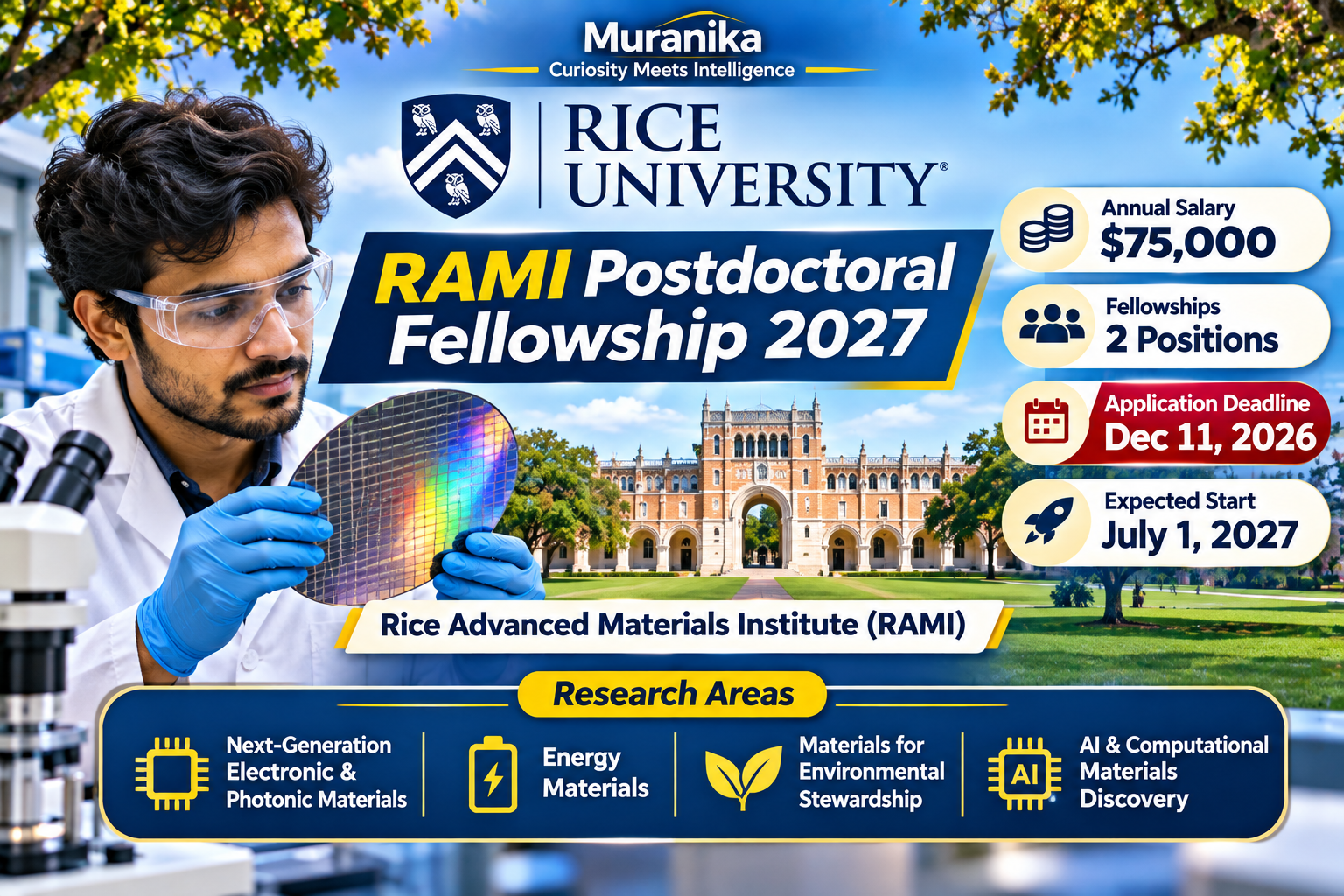
    Looking for a postdoctoral research opportunity in the United States? Rice University has announced its RAMI Postdoctoral Fellowship Program 2027, offering an annual salary of $75,000 for selected researchers working in advanced materials science and engineering.

    The fellowship supports early-career scientists pursuing interdisciplinary research in next-generation electronics, energy materials, environmental sustainability, and advanced materials discovery.

    Applications are currently open, with a deadline of December 11, 2026.

    Rice University RAMI Fellowship 2027: Key Details

    Detail Information
    University Rice University, United States
    Program RAMI Postdoctoral Fellowship 2027
    Research Institute Rice Advanced Materials Institute
    Annual Salary $75,000
    Fellowship Duration Intended for two years
    Expected Fellowships 2
    Application Deadline December 11, 2026, 5 PM CST
    Expected Start Date July 1, 2027

    The appointment is reviewed after the first year. Continuation into the second year depends on satisfactory performance and available funding.

    Research Areas: Who Should Apply?

    The Rice Advanced Materials Institute aims to advance innovative materials research addressing technological, energy, and environmental challenges.

    The program covers three major research areas.

    1. Next-Generation Electronic and Photonic Materials

    This area includes research related to semiconductor materials, microelectronics, advanced devices, quantum materials, two-dimensional materials, materials processing, fabrication, and characterization.

    Researchers working on electronic materials, nanotechnology, thin films, or semiconductor device technologies may find relevant opportunities within this research area.

    2. Energy Materials

    This research area explores innovative approaches to energy storage, energy conversion, and energy harvesting.

    Potential topics include advanced batteries, solid-state materials, thermal energy storage, and materials for more efficient energy technologies.

    3. Materials for Environmental Stewardship

    Researchers interested in environmental sustainability, catalysis, resource recovery, membranes, carbon capture, and materials recycling may find this area relevant.

    Additional research theme: RAMI also welcomes interdisciplinary research involving artificial intelligence, machine learning, computational approaches, and automation to accelerate materials discovery, design, and manufacturing.

    Eligibility Requirements

    Applicants should carefully review the following requirements:

    • Hold a PhD in a discipline relevant to RAMI’s research areas.
    • Have received their PhD in July 2025 or later, or expect to receive it before beginning the fellowship.
    • Have no more than two years of postdoctoral experience at other institutions by July 1, 2027.
    • Have no prior employment as an assistant, associate, or full professor by July 1, 2027.
    • Demonstrate excellent research achievements and strong potential for future scientific contributions.
    • For international nominees, demonstrate eligibility for J-1 Scholar visa status.

    Important: The fellowship requires nomination by an eligible RAMI-affiliated Rice University faculty member. Interested researchers should identify a suitable potential faculty host before preparing their application.

    The institute particularly encourages proposals that connect different materials research disciplines and create new collaborative research directions.

    Required Application Documents

    The application must include:

    1. Curriculum Vitae (CV)

    A research-focused academic CV highlighting qualifications, publications, research experience, presentations, and achievements.

    2. Faculty Nomination Letter

    A nomination letter from the proposed Rice University faculty advisor or advisors explaining the candidate’s research accomplishments and suitability.

    3. Research Proposal

    The research proposal must contain four sections:

    Proposal component Maximum length
    Research objectives and goals 350 words
    Connection to RAMI research areas 150 words
    Research background, challenges, novelty and expected outcomes 1,000 words
    Expected impact on Rice research and future funding opportunities 500 words

    The proposal should follow the university’s specified formatting requirements, including 11-point font and single-spaced text.

    How to Apply for the RAMI Postdoctoral Fellowship

    The process involves identifying an eligible Rice University faculty host, developing an interdisciplinary research proposal, and assembling the required documents.

    The completed application can be submitted by either the candidate or the faculty mentor, provided all required materials are included. The faculty nomination letter may be sent separately according to the institute’s instructions.

    Official program details:

    https://rami.rice.edu/rami-postdoctoral-fellowship-program

    Official application form:

    https://form.jotform.com/260073627903153

    Application deadline: December 11, 2026, at 5 PM Central Standard Time (CST).

    RAMI states that late submissions will only be considered if the initial applications do not meet the required standards. Applicants should therefore aim to submit before the published deadline.

    Selection Process and Fellowship Timeline

    Applications will be evaluated based on the candidate’s scientific achievements, originality of the research proposal, interdisciplinary contribution, and potential impact on Rice University’s materials research activities.

    The institute expects to award approximately two fellowships in this selection round.

    Successful candidates are expected to be announced around the end of January 2027, with appointments scheduled to begin on July 1, 2027.

    Final Thoughts

    The Rice University RAMI Postdoctoral Fellowship 2027 offers an opportunity for eligible early-career researchers to pursue interdisciplinary research in advanced materials, semiconductors, energy technologies, and AI-assisted materials innovation.

    With a $75,000 annual salary and opportunities for research collaboration, the program may appeal to promising PhD graduates seeking to establish an independent research career.

    Interested candidates should review the official eligibility requirements and contact a suitable Rice faculty member early to explore the possibility of nomination.

    Source: Rice Advanced Materials Institute, Rice University.

    Disclaimer: Muranika is an independent information website and is not affiliated with Rice University or its recruitment process. Fellowship details are based on the official announcement reviewed November 13, 2026. Applicants should verify requirements and deadlines directly with the university.

  • Best SIM Card for Japan Travel: eSIM, Tourist SIM & Money-Saving Tips

    Best SIM Card for Japan Travel: eSIM, Tourist SIM & Money-Saving Tips

    Updated November 12, 2026 | Travel | Muranika Editorial Team

    Planning a trip to Japan? One of the first things you’ll need after landing is a reliable internet connection.

    Whether you’re navigating Tokyo’s train stations, exploring Kyoto, visiting Hokkaido, or communicating with family, choosing the best SIM card for Japan travel can make your journey easier.

    But should you buy a tourist SIM card at the airport, order an eSIM before traveling, use international roaming, or rent pocket Wi-Fi?

    Drawing on my personal travel experience and what I’ve learned over more than three years, I’ll explain the options, common mistakes, and practical ways to choose a suitable connection.

    Which SIM Card Is Best for Japan Tourists?

    There isn’t one perfect option for every traveler.

    Japan offers several convenient ways to stay connected.

    Option Best suited for
    Travel eSIM Visitors with compatible smartphones
    Prepaid physical SIM Travelers without eSIM-compatible phones
    Pocket Wi-Fi Families, groups, or multiple devices
    International roaming Travelers prioritizing convenience

    For many tourists with an unlocked, eSIM-compatible smartphone, a prepaid travel eSIM is a convenient starting point because it doesn’t require physically replacing a SIM card.

    However, other options may be more practical depending on your circumstances.

    1. Travel eSIM: A Convenient Option

    Travel eSIMs have made staying connected abroad considerably easier.

    Instead of visiting a mobile store or replacing your existing SIM card, you can purchase a suitable plan online and install the eSIM on a compatible smartphone.

    Providers offering Japan travel eSIM services include Airalo, Ubigi, and Sakura Mobile.

    Before purchasing, check:

    • Whether your smartphone supports eSIM.
    • Whether your device is carrier-unlocked.
    • How much mobile data the plan includes.
    • Whether hotspot sharing is permitted.
    • When the plan’s validity period begins.
    • Which networks the provider uses in Japan.

    Important: Some plans begin when you install the eSIM, while others activate when you connect in Japan. Always follow the provider’s instructions.

    2. Physical Tourist SIM Cards in Japan

    If your smartphone doesn’t support eSIM, a prepaid physical SIM card can still be a practical choice.

    Tourist SIM cards are available through airport counters, electronics retailers such as Bic Camera and Yodobashi Camera, and selected other outlets.

    Some providers also allow advance online reservations.

    However, buying a SIM card only after landing may mean spending time comparing plans when you could already be heading toward your hotel.

    My suggestion is to research your options before departure, even if you plan to purchase the SIM after arriving in Japan.

    3. Pocket Wi-Fi: Better for Some Groups

    Pocket Wi-Fi is another popular option for travelers visiting Japan.

    A portable Wi-Fi router allows several devices to share one mobile internet connection.

    It may be useful for families, group travelers, or anyone carrying a laptop and multiple devices.

    The disadvantages are having to carry and charge another device, along with possible rental and return requirements.

    For solo travelers, a mobile SIM or eSIM may be more convenient.

    4. Do You Need a Japanese Phone Number?

    This is something many travelers overlook.

    Most tourist data-only SIM and eSIM plans provide mobile internet but not a Japanese telephone number.

    You can generally use internet-based services such as WhatsApp, LINE, Google Maps, email, and online booking platforms.

    However, ordinary Japanese phone calls and SMS verification require an appropriate voice-enabled service.

    Some providers offer visitor plans that include a Japanese phone number, but additional identification procedures may apply.

    If you need to receive verification codes on your existing home-country number, check whether your phone can keep that line active alongside your Japan travel SIM.

    5. Common Mistakes to Avoid

    Before purchasing a Japan tourist SIM, consider these practical points:

    • Buying more data than necessary: Estimate your usage based on navigation, messaging, streaming, and hotspot needs.
    • Ignoring compatibility: An eSIM won’t work on every phone.
    • Assuming unlimited means unrestricted: Some plans have speed reductions or separate hotspot limits.
    • Activating too early: Understand when your plan’s validity period starts.
    • Relying entirely on free Wi-Fi: Public networks may not be available everywhere or provide consistent connectivity.

    Comparing the overall plan conditions is often more valuable than simply choosing the cheapest advertised price.

    Watch My Experience: Best SIM Card for Japan Travel

    In my video on Nimble Prerana, I share my experience using mobile connectivity while visiting Japan, along with lessons learned over more than three years.

    I also explain the choices I recommend considering and why certain approaches can be more convenient for visitors.

    Watch: Best SIM Card for Japan Travel | Secret Advice for Visitors

    For readers planning to live in Japan rather than visit temporarily, I also have a separate guide:

    Best SIM for Foreigners in Japan | Mobile SIM Selection Guide

    You may also find my video about scams and unusual experiences in Japan useful when preparing for your visit.

    Final Thoughts: What Should You Choose?

    For a short visit, a travel eSIM is often a convenient choice if your smartphone supports it.

    A physical prepaid SIM remains useful for other devices, while pocket Wi-Fi may work better for groups sharing a connection.

    Rather than assuming one provider is best for everyone, choose based on your trip duration, device compatibility, required data, and total cost.

    A little preparation before landing can save time and make your Japan travel experience smoother.

    Which option would you prefer for Japan: eSIM, physical SIM, or pocket Wi-Fi? Share your experience in the comments.


    Useful Official Resources

    Editorial note: SIM plans, prices, network coverage and activation procedures may change. Verify current conditions with your chosen provider before purchasing.

  • How to Apply for a Schengen Visa From Japan: My Netherlands Experience as an Indian

    How to Apply for a Schengen Visa From Japan: My Netherlands Experience as an Indian

    Updated November 11, 2026 | Travel & Visas | Muranika Editorial Team

    Can you apply for a Schengen visa from Japan if you’re an Indian citizen or another foreign resident? Yes, and you don’t necessarily need to return to your home country to apply.

    As an Indian living in Japan, I went through the Schengen visa application process for travel to the Netherlands. In this guide, I’ll share my experience, explain the application process, and highlight important requirements for international residents of Japan.

    Whether you’re a student, researcher, working professional, or long-term resident, this guide can help you prepare for European travel.

    Can Foreigners Apply for a Schengen Visa From Japan?

    Yes. Foreign nationals legally residing in Japan can apply for a Schengen visa through the appropriate visa application centre.

    For the Netherlands, applications are submitted through VFS Global in Tokyo, which handles the application process on behalf of the Dutch authorities.

    A Schengen short-stay visa generally allows eligible visitors to spend up to 90 days within a 180-day period in the Schengen Area. The actual permitted stay depends on the visa issued.

    If you’re visiting multiple Schengen countries, you should normally apply through the country where you’ll spend the most time. Additional rules apply when the duration of your stay is equal across destinations.

    Documents Required for a Schengen Visa From Japan

    Documentation is one of the most important parts of the application.

    For a Netherlands tourist visa, applicants generally need:

    1. Valid passport: Issued within the previous 10 years, with sufficient remaining validity and at least two blank visa pages.
    2. Japanese residence card: Evidence of legal residence in Japan.
    3. Completed visa application form: Printed and signed using the official online form.
    4. Proof of employment or education: Employment certificates, salary records, or university enrollment documents, depending on your circumstances.
    5. Financial evidence: Recent bank statements and other documents demonstrating sufficient funds.
    6. Travel itinerary: Travel reservations and details of your proposed journey.
    7. Accommodation evidence: Hotel bookings or other acceptable proof of accommodation.
    8. Travel medical insurance: Coverage valid throughout the Schengen Area, including at least €30,000 for qualifying medical expenses.

    The exact checklist depends on your purpose of travel. Always follow the latest official instructions rather than relying only on someone else’s application documents.

    My Experience at VFS Global Tokyo

    I applied through the visa application process in Tokyo and shared the experience on my YouTube channel, Nimble Prerana.

    One interesting observation was the diversity of people applying through the centre. In my video, I discuss applicants from different international backgrounds, including China and African countries.

    The experience highlighted that Schengen visa applications from Japan are relevant to many foreign residents, not only Japanese nationals.

    During a typical VFS appointment, applicants submit their supporting documents and passports, provide biometric information where required, pay applicable fees, and receive information for tracking their applications.

    VFS Global collects applications, while the Dutch authorities make the visa decisions.

    Schengen Visa Fees and Processing Time

    According to official Dutch government information available in November 2026:

    • Adult visa fee: €90.
    • Children aged 6–11: €45.
    • VFS Global service charges: Additional fees apply.
    • Application window: Generally up to six months before the intended trip.
    • Processing time: The Netherlands currently reports an average of approximately 18–21 calendar days, although some applications may take up to 45 days.

    These amounts and processing times can change.

    Applying well before your intended travel date is advisable, particularly during busy holiday seasons.

    Practical Tips Before Applying

    Based on the application process and official guidance, here are some useful recommendations:

    • Prepare documents early and check the current application checklist.
    • Ensure your Japanese residence status remains valid for the required period.
    • Provide a consistent explanation of your travel purpose and itinerary.
    • Show financial stability and your connections to Japan through appropriate documents.
    • Avoid purchasing expensive non-refundable tickets before receiving a decision when a valid travel reservation is sufficient.
    • Keep copies of your documents and application reference number.

    Remember: A complete application improves preparedness but does not guarantee visa approval.

    Watch My Schengen Visa Experience From Japan

    I explain the process in more detail in my original YouTube videos, including the experience of applying in Tokyo and the documents involved.

    Part 1: Applying for a Schengen Visa From Japan

    Watch the original Schengen visa application experience

    Part 2: Schengen Visa Documents and Application Guidance

    Watch the document preparation guide

    These videos were originally published in 2023 and 2025. Applicants should use the updated official requirements provided in this article and the government links below.

    Official Schengen Visa Resources

    For current information, visit:

    Final Thoughts

    Applying for a Schengen visa from Japan is possible for Indian citizens and other eligible foreign residents.

    Understanding the document requirements, selecting the correct destination country, and preparing early can make the process easier to navigate.

    My experience applying for a Netherlands visa from Japan gave me valuable insights that I hope will help other international residents planning to visit Europe.

    Have you applied for a Schengen visa while living in Japan? Share your experience or questions in the comments.


    Disclaimer: This article combines personal experience with official visa information reviewed in November 2026. Requirements, fees, and processing times may change. Always verify the latest instructions with the relevant government authority before applying.

  • Why Do Some People Resist Alzheimer’s? Rare Genes Offer New Clues

    Why Do Some People Resist Alzheimer’s? Rare Genes Offer New Clues

    November 11, 2026 | Science & Discoveries | Muranika Editorial Team

    Why do some people develop Alzheimer’s disease while others remain mentally sharp well into old age, even when they carry genetic risk factors?

    Scientists are investigating this fascinating question by studying individuals who appear unusually resistant to Alzheimer’s-related brain damage.

    A new feature published in Nature on November 10, 2026, highlights growing evidence that rare genetic variations may help protect some people from Alzheimer’s disease, offering promising directions for future research and treatments.

    The Mystery of People Who Resist Alzheimer’s

    Alzheimer’s disease is commonly associated with two abnormal protein changes in the brain:

    • Amyloid-beta: Proteins that accumulate into plaques.
    • Tau: Proteins that form tangles associated with damage to brain cells.

    These changes can contribute to memory loss and cognitive decline.

    However, researchers have identified unusual individuals whose brains contain substantial amyloid deposits but who experience little or no dementia for many years.

    Others remain cognitively healthy despite carrying genes associated with a higher risk of developing Alzheimer’s.

    Understanding these exceptional cases could reveal how the brain naturally protects itself.

    The APOE Gene: A Major Clue

    One of the most important genes being investigated is APOE, which helps regulate the transport of fats and cholesterol throughout the body and brain.

    It has three common forms:

    • APOE2: Generally associated with a lower risk of Alzheimer’s.
    • APOE3: The most common form, typically associated with an intermediate level of risk.
    • APOE4: Associated with a substantially increased risk of Alzheimer’s disease.

    But scientists have discovered something particularly interesting: rare changes within these genetic forms may alter how the brain responds to disease.

    Researchers have identified three rare variants of APOE3 associated with exceptional resilience and one APOE4 variant that appears to counteract its usual risk.

    These findings suggest that small genetic differences can influence whether damaging processes develop or progress.

    The Rare Christchurch Variant

    One especially promising discovery involves a rare form of APOE3 known as the Christchurch variant.

    Researchers believe this variant may interfere with the movement and accumulation of harmful tau proteins between brain cells.

    Some other protective APOE3 variants appear to influence how the ApoE protein interacts with fatty molecules, potentially reducing harmful protein aggregation.

    Studies involving human cells and experimental models are helping scientists investigate these protective mechanisms.

    However, the effects can vary depending on the individual’s genetic background.

    Scientists Are Looking Beyond European Populations

    Geneticist Henne Holstege of Amsterdam University Medical Centre began studying people with unusual resilience to neurodegeneration in 2013.

    Research teams are now examining large genetic databases to identify protective mutations that might otherwise go unnoticed.

    One important development is the growing inclusion of people from different ancestral backgrounds.

    For example, researchers have identified a rare potential protective variant called W276C in individuals with Native American ancestry.

    Such discoveries highlight why genetic diversity matters in Alzheimer’s research.

    A gene variant that is rare or absent in one population might provide important clues in another.

    Could These Discoveries Lead to New Treatments?

    Scientists have identified approximately a dozen rare genetic variants with varying levels of evidence suggesting protection against Alzheimer’s.

    The long-term objective is to understand how these variants influence processes such as amyloid accumulation, tau movement, inflammation, and brain-cell survival.

    These findings could eventually support the development of treatments that imitate the protective effects of naturally occurring genetic changes.

    However, this research has not yet produced a proven treatment that makes people resistant to Alzheimer’s.

    Researchers still need to establish how these mechanisms work and whether they can be translated into safe, effective therapies.

    Final Thoughts

    For decades, Alzheimer’s research has focused heavily on understanding what causes the disease.

    Now, scientists are also asking a different question: What prevents some vulnerable people from developing dementia?

    The answer may lie partly in rare genetic differences that strengthen the brain’s natural defenses.

    Although practical treatments remain a future possibility, studying these exceptional individuals could help scientists discover new ways to delay or reduce Alzheimer’s-related damage.

    What do you think? Could understanding naturally protective genes change the future of Alzheimer’s treatment? Share your perspective in the comments.


    Sources and Further Reading

    Medical note: This article discusses emerging scientific research and is not intended as medical advice or a recommendation for genetic testing.

  • How to Write a Research Plan for the MEXT Scholarship: A Step-by-Step Guide

    How to Write a Research Plan for the MEXT Scholarship: A Step-by-Step Guide

    Updated November 11, 2026 | Education & Careers → MEXT Scholarships | Muranika Editorial Team

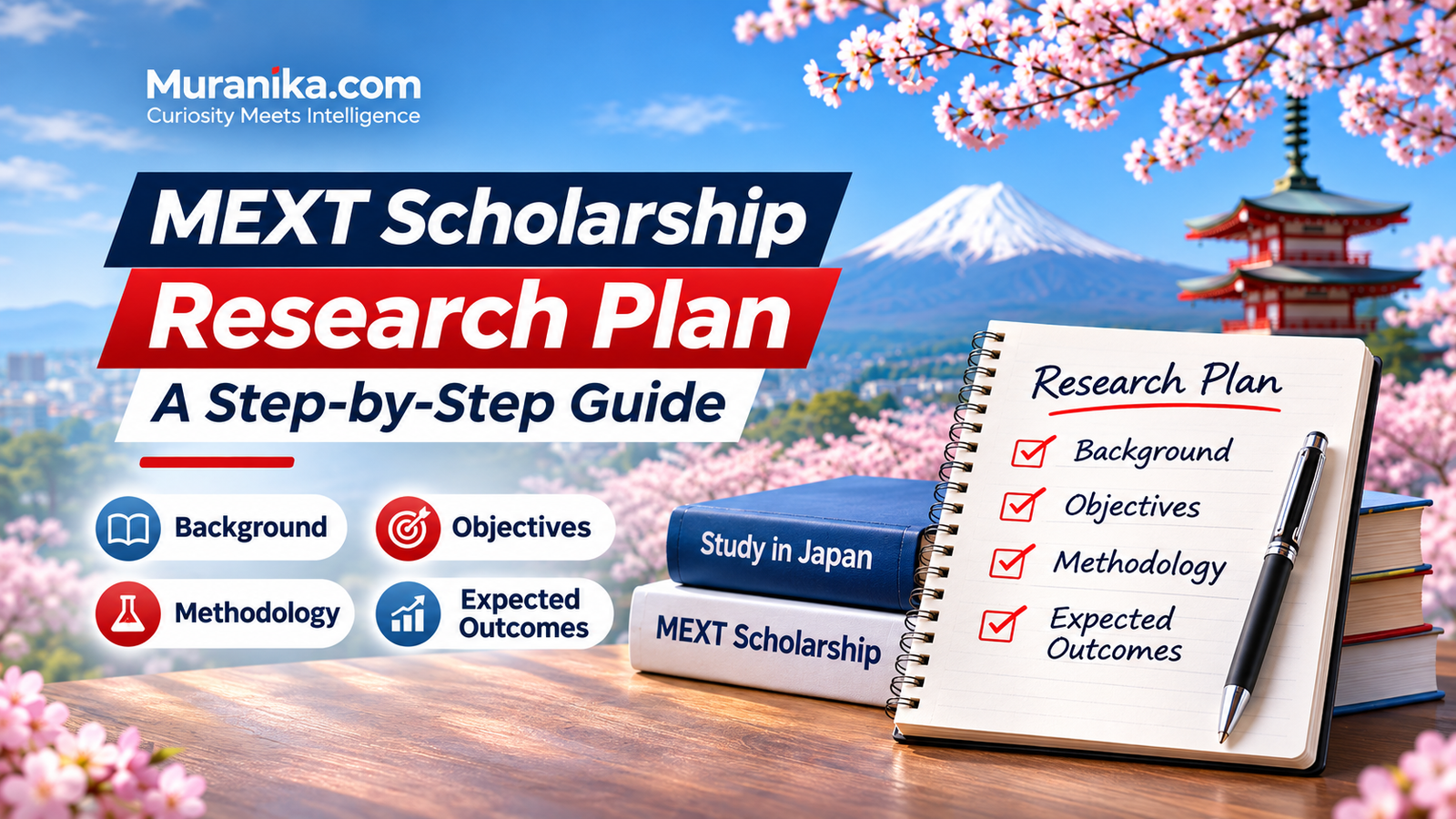
    Planning to pursue a master’s degree, PhD, or research programme in Japan through the MEXT Scholarship? One of the most important documents you may need is a well-structured research plan.

    A strong research plan explains not only what you want to study, but also why your research matters, how you intend to carry it out, and what you expect to achieve.

    Whether you’re preparing for the MEXT 2027 selection cycle or exploring future opportunities, understanding how to present your research ideas can help strengthen your application.

    What Is a MEXT Scholarship Research Plan?

    The research plan is a document describing your proposed academic research in Japan.

    For the Embassy Recommendation research-student pathway, the official document is called the Field of Study and Research Plan.

    It helps reviewers understand your academic background, proposed research direction, and preparedness for graduate-level research.

    Applicants should use the official format and instructions for their application year. University Recommendation programmes may have additional or different requirements.

    5 Essential Components of a Strong Research Plan

    1. Research Background

    Introduce your research area and explain the problem you want to investigate.

    Briefly describe existing research, identify a knowledge gap, and explain why your proposed study is relevant.

    2. Research Objectives

    Clearly define what you aim to accomplish.

    Instead of making broad statements, identify specific research questions or objectives that can realistically be addressed during your proposed study period.

    3. Research Methodology

    Explain how you plan to conduct your research.

    Depending on your discipline, this may include experiments, simulations, surveys, data analysis, laboratory investigations, or theoretical methods.

    The methodology should connect directly to your research objectives.

    4. Expected Outcomes

    Describe the results or contributions you hope your research will produce.

    These might include new scientific knowledge, improved processes, analytical methods, technological applications, or solutions to practical problems.

    Avoid promising results that cannot reasonably be guaranteed.

    5. Research Significance

    Explain why your proposed research matters to your field and what value it may offer.

    You can also discuss how studying in Japan would support your research, particularly when relevant university laboratories, expertise, or facilities align with your proposal.

    Common Research Plan Mistakes to Avoid

    Applicants sometimes weaken their proposals by:

    • Choosing topics that are too broad or poorly defined.
    • Providing insufficient background or research justification.
    • Presenting unrealistic objectives or research timelines.
    • Describing methods without explaining how they answer the research questions.
    • Failing to demonstrate a connection between previous academic experience and proposed research.
    • Submitting a generic plan without considering the intended university or research environment.

    A good research plan doesn’t need unnecessarily complicated language. Clarity, feasibility, and academic relevance are more valuable than impressive terminology.

    Watch: How to Prepare Your MEXT Research Plan

    For a more detailed explanation, watch our video covering research background, objectives, methodology, expected outcomes, and common application mistakes.

    Watch: MEXT Field of Study and Research Plan 2.0

    The video provides practical guidance for organizing your research ideas and preparing a stronger proposal.

    Additional MEXT Scholarship Resources

    You may also find these educational videos useful:

    These videos share educational guidance and experiences from scholarship recipients. Older selection dates and procedures should always be checked against current official announcements.

    Where to Find the Official MEXT Research Plan Form

    Applicants should download the appropriate documents directly from official Japanese government sources.

    Study in Japan — MEXT Scholarship 2027 Research Student Application

    For University Recommendation, consult the prospective university’s admissions and scholarship instructions.

    Final Thoughts

    Preparing a successful MEXT research proposal requires more than choosing an interesting topic. It involves identifying a meaningful research problem, developing achievable objectives, and demonstrating a realistic plan for investigating it.

    Start early, understand your chosen research field, and revise your proposal carefully before submission.

    A thoughtful research plan can help communicate your academic potential, although scholarship selection depends on multiple evaluation factors.

    What is the biggest challenge you’re facing while preparing your MEXT research plan? Share your question in the comments.


    Editorial note: This guide is intended for educational purposes. Always follow the latest MEXT application guidelines and instructions issued by your Japanese embassy or prospective university.

  • Alix Earle Supports Sofia Franklyn’s New Book: Is Alex Cooper Drama Back?

    Alix Earle Supports Sofia Franklyn’s New Book: Is Alex Cooper Drama Back?

    November 11, 2026 | Entertainment & Culture | Muranika Editorial Team

    A simple TikTok video has brought renewed attention to one of the podcast world’s most talked-about controversies.

    Social media personality Alix Earle has publicly shown support for Sofia Franklyn’s new memoir, Daddy Issues, raising fresh speculation about her relationship with Call Her Daddy host Alex Cooper.

    The timing is particularly interesting because both Earle and Franklyn have previously experienced professional disagreements involving Cooper.

    But what exactly happened, and why are fans connecting the dots?

    Alix Earle’s TikTok Gets People Talking

    Alix Earle shared a TikTok video showing herself reading Sofia Franklyn’s memoir, Daddy Issues, which was released on November 10, 2026.

    She also joked about her earlier claim in an Interview magazine Q&A that she had never read a book.

    The lighthearted video quickly attracted attention because Franklyn’s memoir revisits her widely publicized separation from former podcast partner Alex Cooper.

    Although Earle did not directly criticize Cooper in the video, her decision to feature the book has been interpreted by some observers as a subtle show of solidarity with Franklyn.

    Why Did Sofia Franklyn and Alex Cooper Fall Out?

    Franklyn and Cooper originally co-hosted the hugely successful Call Her Daddy podcast under Barstool Sports.

    Their partnership ended in 2020 following disagreements about contract negotiations and ownership of the podcast.

    Franklyn’s then-boyfriend, Peter Nelson, reportedly encouraged the hosts to pursue opportunities outside Barstool.

    Cooper, meanwhile, favored extending their arrangement for another year while negotiating intellectual property rights.

    The disagreement eventually ended their professional partnership.

    Cooper continued hosting Call Her Daddy independently and later secured major agreements, including a reported $60 million Spotify deal in 2021 and a $125 million SiriusXM deal in 2024, covering advertising and distribution rights associated with the podcast and her Unwell Network.

    Franklyn subsequently developed her own podcast, Sofia with an F.

    What Happened Between Alix Earle and Alex Cooper?

    The connection between Earle and Cooper began in August 2023, when Cooper signed the TikTok personality to her newly established Unwell Network.

    Earle’s podcast, Hot Mess, became one of the network’s early projects.

    However, in February 2025, Variety reported that Unwell had dropped the podcast. SiriusXM also reportedly stopped selling advertising for the programme, while Unwell relinquished its rights to the show.

    The announcement fueled rumors of tension between the two creators.

    Sources speaking to Us Weekly claimed that business disagreements had damaged their friendship.

    Cooper subsequently stated that Earle’s podcasting break was unrelated to Unwell and maintained that Earle retained ownership of her intellectual property.

    Their differing public accounts and the surrounding speculation have continued to attract online attention.

    What Does Sofia Franklyn Reveal in Daddy Issues?

    Franklyn’s 256-page memoir, published by Simon & Schuster, explores her personal experiences, career, friendships, and the aftermath of her departure from Call Her Daddy.

    She first announced the project in February 2026, explaining that writing about her experiences required personal reflection and confronting difficult memories.

    The book offers Franklyn’s perspective on the breakdown of her relationship with Cooper, alongside other experiences from her life.

    Its release has renewed interest in a controversy that originally began six years earlier.

    Is Alix Earle Taking Sofia Franklyn’s Side?

    Earle’s TikTok clearly brought additional attention to Franklyn’s new book.

    However, there has been no confirmation that the post represents a coordinated public challenge to Alex Cooper.

    For now, the connection remains a matter of interpretation.

    What is certain is that a new memoir, a familiar podcast

  • Japan Updates List of 93 Universities for Two-Year Job Search Stay: Who Qualifies?

    Japan Updates List of 93 Universities for Two-Year Job Search Stay: Who Qualifies?

    November 10, 2026 | Education & Careers | Muranika Editorial Team

    Japan has updated its list of 93 universities whose eligible graduates may qualify to stay in the country for up to two years while searching for employment or preparing to launch a business.

    The updated list, announced by Japan’s Immigration Services Agency on November 4, 2026, is part of the country’s J-Find (Future Creation Talent) immigration programme.

    The initiative offers graduates from highly ranked universities an opportunity to explore careers and entrepreneurship in Japan without first securing a job offer.

    What Is Japan’s J-Find Visa?

    Introduced in April 2023, J-Find provides eligible graduates with a special residence status called Designated Activities (Future Creation Talent).

    Under this programme, qualifying individuals may:

    • Stay in Japan for up to two years while seeking employment.
    • Explore opportunities to establish a business.
    • Undertake permitted work activities to support their stay.
    • Bring eligible spouses and children under applicable immigration rules.

    The two-year period is a maximum, and residence extensions are subject to immigration procedures and approval.

    Who Can Apply for J-Find?

    According to Japan’s Immigration Services Agency, applicants must satisfy three main conditions:

    1. University qualification: Hold an eligible degree from a university ranked among the world’s top 100 in at least two of three major global rankings: QS, Times Higher Education (THE), and Academic Ranking of World Universities (ARWU).
    2. Recent graduation: Have obtained the qualifying degree within the previous five years.
    3. Financial resources: Possess at least ¥200,000 to cover initial living expenses.

    Meeting these conditions does not automatically guarantee visa approval.

    Which Universities Are Included?

    The October 2026 list contains 93 universities across several countries and regions.

    Examples include Harvard University, Stanford University, Massachusetts Institute of Technology (MIT), University of Oxford, University of Cambridge, National University of Singapore, and Nanyang Technological University.

    Japan’s published list also includes the University of Tokyo and Kyoto University.

    The universities are predominantly located in the United States, United Kingdom, China, and other parts of Asia and Europe.

    What About Graduates From India and Africa?

    One notable aspect of the updated list is that no universities located in India or Africa appear among the 93 institutions.

    This means a degree obtained solely from an Indian or African university does not satisfy the current listed-university requirement.

    However, nationality itself is not the deciding factor. An Indian, Nigerian, or other international graduate who earned a qualifying degree from an eligible institution may still satisfy the educational requirement.

    Applicants should verify all applicable immigration conditions before applying.

    Does J-Find Guarantee Employment in Japan?

    No. The programme provides time to search for opportunities, but it does not guarantee a job, salary, or long-term residence.

    Graduates who secure suitable employment generally need an appropriate employment-related residence status to continue working beyond the permitted activities and duration of J-Find.

    The scheme is particularly relevant to internationally educated graduates exploring Japan’s technology, engineering, research, and business sectors.

    Where Can You Check the Official University List?

    Japan’s Immigration Services Agency updated its eligible university list on November 4, 2026, using rankings current as of October 2026.

    Because university rankings and eligibility lists can change, applicants should confirm the latest requirements before submitting an application.

    Official information: Japan Immigration Services Agency

    Latest government announcements: Immigration Services Agency Updates

    Final Thoughts

    Japan’s J-Find programme offers a potentially valuable pathway for eligible international graduates who want to explore employment or entrepreneurship in the country.

    However, the university ranking requirement remains a significant limitation, particularly for applicants who studied at institutions outside the current list.

    For graduates considering Japan as their next career destination, checking eligibility early can help avoid unnecessary application expenses and disappointment.

    Would you consider moving to Japan if you had two years to explore career opportunities? Share your thoughts in the comments.


    Sources: Japan Immigration Services Agency, official J-Find programme guidance and November 4, 2026 update; Legit.ng report published November 4, 2026.

    This article provides general information and does not constitute immigration or legal advice.