

India and Denmark have adopted a new five-year Joint Action Plan, signalling an effort to deepen a partnership that now reaches well beyond diplomacy and trade. The announcement came on 28 November 2026, when External Affairs Minister S. Jaishankar and Danish Foreign Minister Lars Løkke Rasmussen co-chaired the fifth India-Denmark Joint Commission Meeting in New Delhi. The Tribune’s ANI report covered the announcement.
The two sides exchanged agreements covering cultural exchange, skill development, vocational education and entrepreneurship, alongside cooperation between India’s International Financial Services Centres Authority and Denmark’s Financial Supervisory Authority. Their discussions also covered water, renewable energy, green shipping, health, agriculture, food processing, science and technology, space, education, mobility and security. Hindustan Times reported on the wider agenda and the agreements.
A broader agenda for a changing relationship
The plan builds on the Green Strategic Partnership established in 2020. That framework connects Denmark’s experience in clean energy, water management and sustainable urban development with India’s scale, infrastructure needs and growing market. The previous Joint Action Plan (2021–2026) covered energy and climate, water and circular economy, smart cities, trade, maritime cooperation, science, agriculture and health. Read the Danish government’s background on the earlier plan.
The new agenda gives greater visibility to skills, vocational education, entrepreneurship, financial regulation and emerging technologies, while keeping green transition at its centre. Climate cooperation increasingly depends on people and institutions as much as equipment: engineers, technicians, researchers, regulators, entrepreneurs and local authorities all have a role in delivering projects.
Why skills and business links matter
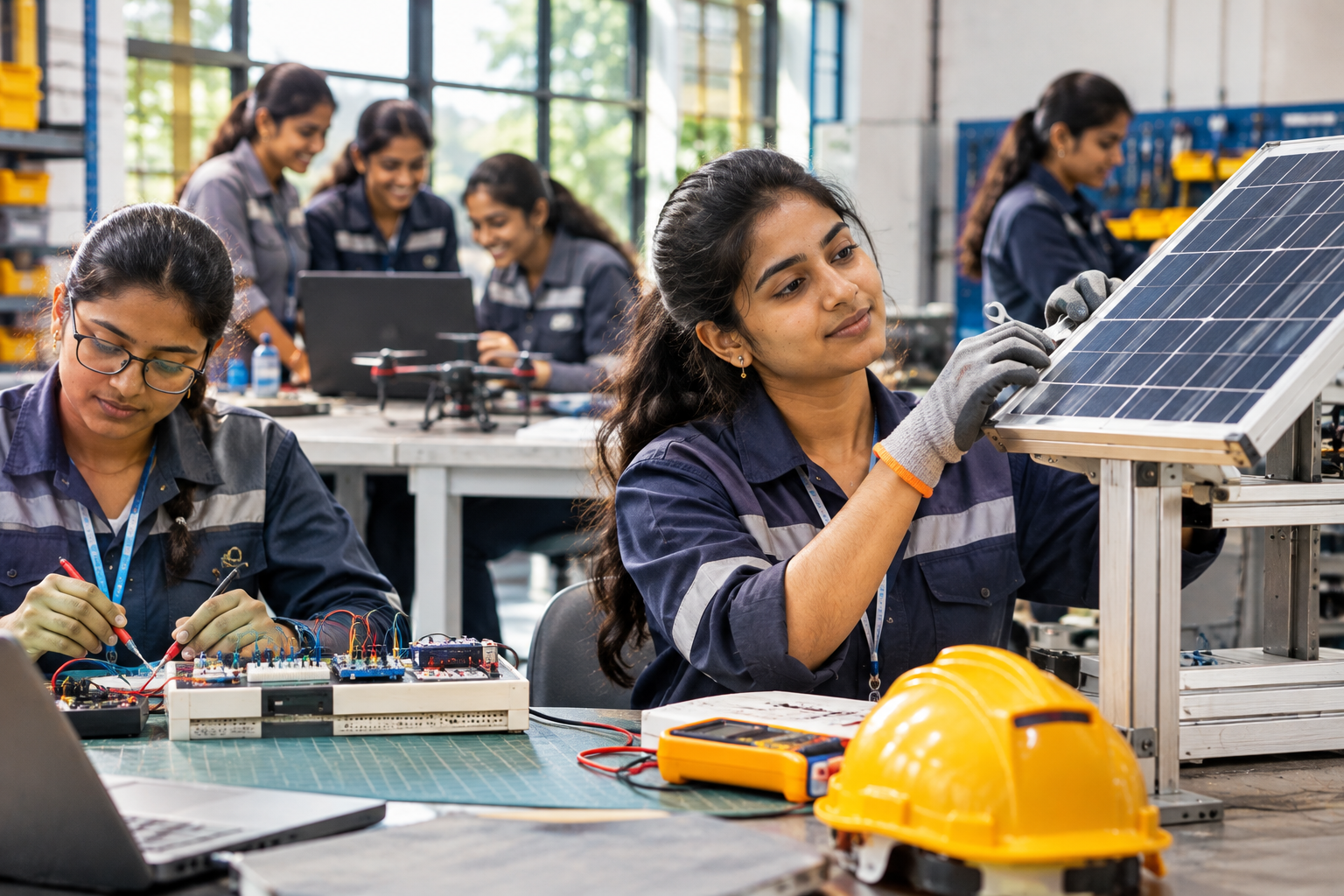
The skills agreement is one of the most tangible parts of the announcement. Stronger links between vocational education and training institutions can support curriculum exchange, institutional partnerships and a closer understanding of industry needs. It may also help businesses identify relevant capabilities as they expand across borders.
However, the agreement should not be mistaken for a new visa route, guaranteed employment programme or automatic recognition of qualifications. Those outcomes would require separate rules and implementation.
There is already a business foundation to build on. A Government of India background note published in May 2026 put bilateral trade in goods at about US$2.05 billion in 2025 and trade in services at US$4.25 billion. It also noted around 200 Danish companies with investments in India and roughly 40 Indian companies operating in Denmark. The challenge now is to deepen and diversify these links. Source: Press Information Bureau.
Where cooperation could become tangible
Water management, renewable energy and green shipping remain important pillars. The latest discussions also included a Maharashtra-focused sustainable water-management agreement involving the state, the municipalities of Solapur and Umred, Danish water expertise and the city of Aarhus. Project-level cooperation like this can connect diplomatic commitments with local needs and measurable outcomes. Hindustan Times has details of the Maharashtra agreement.
Other areas—including quantum technology, space, research and industrial cooperation—could widen the partnership. During his visit, Rasmussen also met technology and research institutions in Bengaluru, including C-CAMP, QpiAI, ISRO and Hindustan Aeronautics Limited, reflecting interest in innovation and industrial links. The Tribune reported on the Bengaluru engagements.
What happens next?
An action plan is a roadmap, not proof that every proposed project has been funded or launched. Its success will depend on follow-up by ministries, regulators, companies, universities and local governments. Watch for implementation timelines, pilot projects, new investments, training partnerships and measurable progress in water and clean-energy initiatives.
One date distinction is worth noting. Jaishankar’s public statement described the new plan as 2026–2031, while a Hindustan Times report referred to the cooperation period as 2027–31. The five-year framework is clear, but the precise calendar framing should be read alongside the final published document. DD India’s report also records Jaishankar’s 2026–31 wording.
For India, Denmark offers established green-technology capabilities and a strong interest in skilled talent. For Denmark, India offers scale, a large talent pool and opportunities across infrastructure, technology and manufacturing. The opportunity is significant—but the real measure of this partnership will be what gets delivered on the ground.
Sources and further reading
- The Tribune / ANI: India and Denmark adopt the Joint Action Plan
- Hindustan Times: Five-year action plan and green strategic partnership
- Akashvani News: Fifth India-Denmark Joint Commission Meeting
- Ministry of Foreign Affairs of Denmark: Previous Joint Action Plan
- Press Information Bureau: India-Nordic cooperation background note

Leave a Reply